How to create a successful business plan for a hostel

Have you hung up your backpack after several years travelling between different countries and hostels, meeting new faces, and immersing yourself in countless local cultures?
If so, you might be ready to welcome the next generation of backpackers - by opening your own hostel.
To ensure its success, however, you'll need to create a business plan for a hostel to help you set out the vision for your business and identify its funding requirements.
A lot of entrepreneurs struggle with writing a business plan owing to lack of experience or knowhow. Luckily for you, The Business Plan Shop is here to help!
From market research to creating a financial forecast, we guide you through all the steps needed to create a business plan for a hostel.
Why write a business plan for a hostel?
For any entrepreneur, regardless of whether they're launching a restaurant, bakery, or clothes shop, writing a business plan is the very first step in starting a new company.
Not only does it enable you to check whether the business is likely to be profitable, but it also plays an essential role in presenting your business to potential lenders or investors in the hope they'll feel as excited about it as you are and provide funding to help get it off the ground.
A business plan consists of two main components:
- A financial forecast that aims to highlight the expected profitability of the business and its need for initial financing
- A written part that presents, in detail, your project, the team, your business strategy, and your medium-term objectives.
Before you dive headfirst into writing your business plan, you'll need to gather the information necessary to piece it together. Let's look at them in a bit more detail.
Need a convincing business plan?
The Business Plan Shop makes it easy to create a financial forecast to assess the potential profitability of your projects, and write a business plan that’ll wow investors.
What information is needed to create a dormitory business plan?
Writing a dormitory business plan requires research so that you can project sales, investments and cost accurately in your financial forecast.
In this section, we cover three key pieces of information you should gather before drafting your business plan!
Carrying out market research for a hostel
Before writing a business plan for a hostel, you need to first familiarise yourself with the hostel market and verify whether there's enough room on the local market for you to open a hostel in your desired area. This is known as the market research stage.
By carrying out market analysis for a business plan, you'll obtain critical knowledge of the current demand for hostel accommodation, as well as the hostels that have already made their name on the market.
Thanks to this data, you'll then be able to determine which customer segment to target (whether it be young groups of friends or solo travellers) so that your hostel can take up its own space on the market.
The market research will also enable you to collect the information needed to estimate your turnover, as you'll get a better idea as to how you'll set your prices, as well as the average turnover of other hostels in the area.
For example, market research for your hostel might reveal that an increasing number of travelers could prefer eco-friendly accommodations. Guests may look for hostels that emphasize sustainable practices, such as using solar energy, providing recycling options, and offering locally sourced, organic food.
Another trend that could emerge is a growing interest in digital nomadism. Your hostel might attract more long-term guests who seek reliable Wi-Fi, co-working spaces, and comfortable areas for remote work, suggesting that enhancing these amenities could significantly boost your appeal to this demographic.
Developing the sales and marketing plan for a hostel
As you embark on creating your hostel business plan, it is crucial to budget sales and marketing expenses beforehand.
A well-defined sales and marketing plan should include precise projections of the actions required to acquire and retain customers. It will also outline the necessary workforce to execute these initiatives and the budget required for promotions, advertising, and other marketing efforts.
This approach ensures that the appropriate amount of resources is allocated to these activities, aligning with the sales and growth objectives outlined in your business plan.
The staffing and equipment needs of a hostel
As you embark on starting or expanding your hostel, having a clear plan for recruitment and capital expenditures (investment in equipment and real estate) is essential for ensuring your business's success.
Both the recruitment and investment plans must align with the timing and level of growth projected in your forecast, and they require appropriate funding.
A hostel might incur staffing costs such as salaries for receptionists, housekeeping staff, and maintenance personnel.
Additionally, equipment costs could include purchasing new beds and mattresses, upgrading kitchen appliances, and installing security systems like CCTV cameras and electronic key card access.
To create a realistic financial forecast, you also need to consider other operating expenses associated with the day-to-day running of your business, such as insurance and bookkeeping.
With all the necessary information at hand, you are ready to begin crafting your business plan and developing your financial forecast.

What goes into your hostel's financial forecast?
Once you've gathered all the data mentioned above, it's time to start writing your business plan.
Here are the four tables that make up the financial forecast of your dormitory business plan:
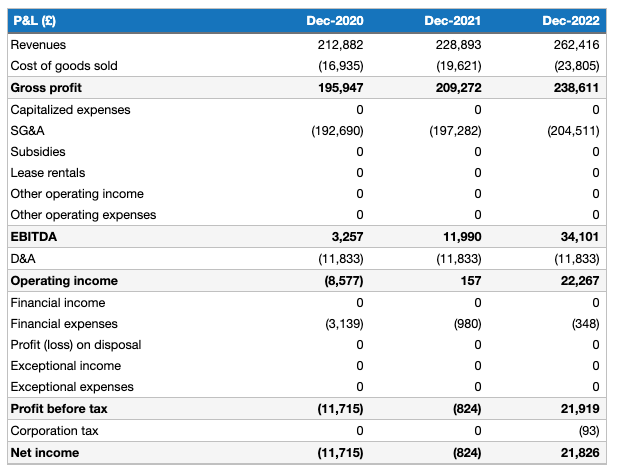
The projected P&L statement
With this table, you can evaluate the expected growth and profitability of your hostel over its first three years of operation.
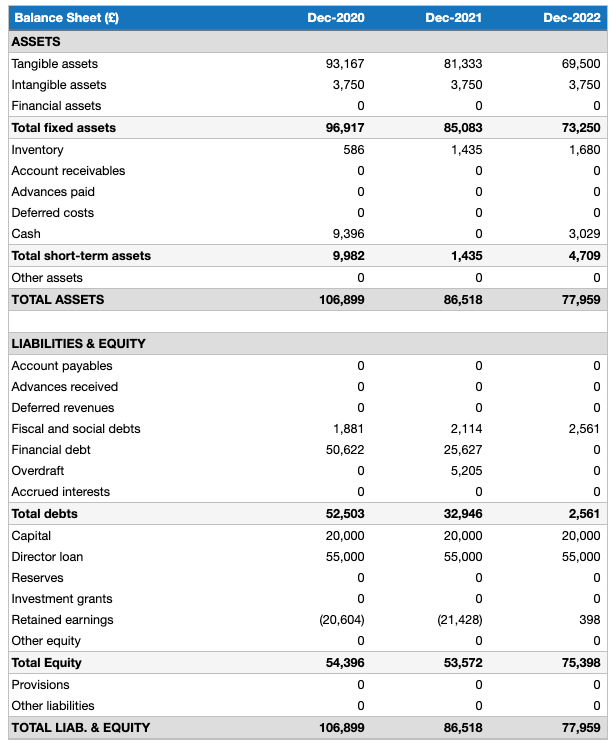
The projected balance sheet
The projected balance sheet is made up of two parts. It shows the assets, i.e. what your hostel owns (such as cash, stock, and equipment), and the liabilities, i.e. what your company owes to its creditors at the end of the year.
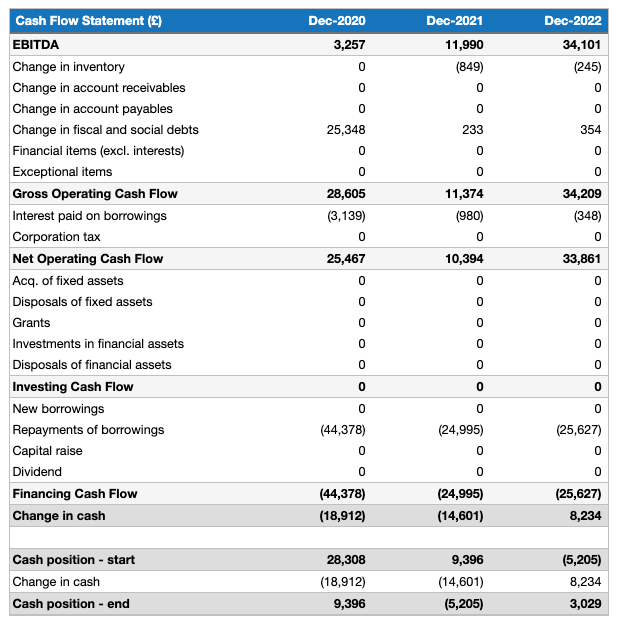
The projected cash flow statement
The cash flow statement enables you to observe the amount of cash consumed or generated by the company during a fiscal year.
With this table, you can verify whether the company has sufficient cash flow to meet its financial commitments (especially when it comes to loan repayments) and regularly renew its equipment.
Initial financing plan
The initial financing plan shows how the company's initial investment is financed.
This table is also useful for estimating the distribution of risk at the beginning of activity between the shareholders and the lenders.
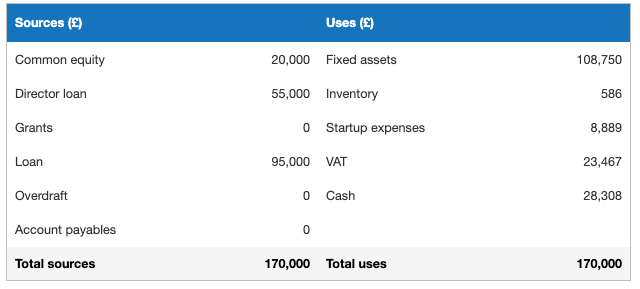
There are two sides to this table:
- Sources (capital contributions, loans etc.), i.e. the money available to the business
- Uses (equipment, start-up costs, etc.) i.e. how this money is used at the launch of the business
Ideally, the cash position shown in the initial financing plan should be sufficient to keep the business afloat until you reach your break-even point if your business takes longer than expected to start up.
Need a convincing business plan?
The Business Plan Shop makes it easy to create a financial forecast to assess the potential profitability of your projects, and write a business plan that’ll wow investors.
The written part of a hostel business plan
Once the financial forecast of your hostel has been created, it's time to tackle the editorial part.
This crucial part of the business plan enables you to present your business idea in detail. By putting the figures into context, the written part gives the potential investor reading the plan an understanding of your motivation for launching the business, your involvement in it, the strengths of your business model, and how you plan to manage its risks.
The editorial part of a dormitory business plan is made up of the following sections:
The executive summary
The executive summary is the very first thing an investor will come across when reading your business plan.
Its purpose is to present your business by telling your story - who you are, where you're based, what product or service you're selling, and, most importantly, what you need from the reader to make it come to life.
The executive summary should make the reader want to find out more about the project, so make it as compelling and concise as possible
Company
In this section, you'll highlight the structure of your hostel by detailing its legal status, business partners, how capital will be distributed and the company's location.
Products and services
Here you will describe the type of accommodation offered in your hostel, counting the amount of dormitory and beds, as well as all the facilities you offer (toilets, a bar, laundry service, etc).

Market research
This part should not be neglected. You will present here the conclusions of your market research with the objective of convincing the potential investor reading your plan that there is indeed a business opportunity to be seized.
Strategy
In this part, you'll reveal three key plans:
- Your sales strategy - the prices you'll set
- Your marketing strategy - the actions you'll take to attract customers and build customer loyalty
- Your risk management strategy - how you'll minimise the risks related to your business
Placing a spotlight on these will show potential investors that you've given your project a lot of thought and anticipated the risks involved in running the business over the long term.
Operations
This is where you will detail the day-to-day running of your hostel - from how many people will be needed to man the reception or the bar, to which suppliers you'll be using and how often.
The financial plan
Your calculations and assumptions will be illustrated in the financial plan section where you will find the tables we touched upon earlier.

What tool should I use to write my hostel's business plan?
There are three main ways of creating your hostel business plan:
- Using specialized business planning software,
- Hiring a business plan writer,
- Use Word or Excel.
Using Word or Excel to create your business plan for a hostel
While this solution is the least expensive, it's the most tedious and time-consuming. Unless you have impeccable office skills and prior accounting knowledge, miscalculations will be likely - so we advise you to browse the other options below before making up your mind.
Hiring a consultant to write your financial forecast
Hiring a chartered accountant or consultant to take care of the financial part of your business is a good way to avoid errors.
However, the fees are generally quite expensive: budget around £1.5k ($2.0k) for a complete business plan, more if you need to make changes after the initial version (which happens frequently after the initial meetings with lenders).
We also advise choosing someone with previous experience in the hostel field, so they can provide advice specifically tailored to your industry.
Need a convincing business plan?
The Business Plan Shop makes it easy to create a financial forecast to assess the potential profitability of your projects, and write a business plan that’ll wow investors.
Using online business plan software
You also have the possibility to use online business plan software to draft up your dormitory business plan.
There are several advantages to using specialised software:
- You can easily create your financial forecast by letting the software take care of the financial calculations for you without errors
- You are guided through the writing process by detailed instructions and examples for each part of the plan
- You can access a library of dozens of complete business plan samples and templates for inspiration
- You get a professional business plan, formatted and ready to be sent to your bank or investors
- You can easily track your actual financial performance against your financial forecast
- You can create scenarios to stress test your forecast's main assumptions
- You can easily update your forecast as time goes by to maintain visibility on future cash flows
- You have a friendly support team on standby to assist you when you are stuck
If you are interested in this type of solution, you can try our software for free here.
Need a convincing business plan?
The Business Plan Shop makes it easy to create a financial forecast to assess the potential profitability of your projects, and write a business plan that’ll wow investors.
Hostel business plan template
It's much easier to begin with a hostel business plan example rather than a blank page - especially if you haven't drafted a business plan before.
Which is why you can draw inspiration from our hostel business plan template to write your own plan in no time.
Our hostel business plan template contains:
- A complete three-way financial forecast (P&L, balance sheet and cash flow forecast)
- A complete written business plan detailing all aspects of the company
Load the sample hostel business plan template directly in our software and simply replace the text and numbers with your business' details to make it your own.
Takeaways
- A business plan has 2 complementary parts: a financial forecast showcasing the expected growth, profits and cash flows of the business; and a written part which provides the context needed to judge if the forecast is realistic and relevant.
- Having an up-to-date business plan is the only way to keep visibility on your hostel's future cash flows.
- Using business plan software is the modern way of writing and maintaining business plans.
That's it for this time, we hope this article has helped you better understand how to write a business plan for a hostel. If you have any questions related to launching your business, please don't hesitate to get in touch with our team.
Also on The Business Plan Shop
- Business plan template for a hostel
- Why do you need a business plan?
- How to open a hostel
- Example and tips to present your management team in a business plan
- Accountant or business plan writer?
- How to write the structure and ownership section of your business plan?
Know someone else who might be interested in this article? Share it with just one click!

Founder & CEO at The Business Plan Shop Ltd