How to do a market analysis for a business plan?

A key part of any business plan is market analysis. This section needs to demonstrate both your expertise in your particular market and the attractiveness of the market from a financial standpoint.
In this guide, we look at what is a market analysis before looking at how to make a good one for your business plan.
Let's dive in!
What is the role of a market analysis in a business plan?
In this section, we take a look at the definition of both a market analysis and a business plan and explain how the market analysis section plays a pivotal role in your business plan.
What is a market analysis?
A market analysis is a quantitative and qualitative assessment of a market. It looks into the size of the market both in volume and in value, the various customer segments and buying patterns, the competition, and the economic environment in terms of barriers to entry and regulation.
Now that we are clear on what a market analysis is, let's define what we mean by business plan.
What is a business plan?
A business plan is a comprehensive document outlining the goals, strategies, and operations of a business. It serves as a roadmap for entrepreneurs, guiding them through the various stages of starting, managing, and growing their ventures.
There are two essential parts to a business plan:
- A numerical part, the financial forecast, which highlights the amount of initial financing needed to launch or grow the business, and the expected growth, profitability and cash generation over the next 3 to 5 years,
- A written part, which presents in detail the business and provides the necessary context to enable the reader of the business plan to judge the relevance and coherence of the figures included in the forecast.
A well-crafted business plan not only articulates the company's vision and mission but also provides a detailed analysis of its market, financial projections, and operational plans.
How does the market analysis section serve your business plan?
The objectives of the market analysis section of a business plan are to show to investors or lenders reading the business plan that:
- You (the entrepreneur) know your target market inside-out
- The market is large enough to build and grow a sustainable business
To do so, you will need to walk the reader of your business plan through the ins and outs of your target market: who are the customers, why do they buy, who are the main players (competitors, suppliers), what are the rules and regulations, what are the key trends, etc.
The data presented in your market analysis will need to be backed by reliable sources, in order to gain the reader's trust and boast you credibility as an entrepreneur who means business.
And your analysis should gently steer the reader towards the conclusion that there is an opportunity to be seized on your target market.
Now that we understand its significance, let's dissect the key components of market analysis that enrich a business plan.
Need a convincing business plan?
The Business Plan Shop makes it easy to create a financial forecast to assess the potential profitability of your projects, and write a business plan that’ll wow investors.
How to present a market analysis in a business plan?
At The Business Plan Shop we recommend using the following outline which follows a logical progression:
The first step of the analysis is to assess the market size.
Demographics and segmentation
Scope
When assessing the size of the market, your approach and focus will depend on the type of business you run (and are selling to investors in your business plan).
If you are writing a business plan for a small local shop or a restaurant, then you need to take a local approach and try to assess the market around your shop.
If you are writing a business plan for a national restaurant chain, then you need to assess the market at a national level.
Depending on the characteristics of your market, you might also want to slice it into different segments. This is especially relevant if you or some of your competitors focus only on certain segments.
Volume & Value
There are two factors you need to look at when assessing the size of a market: the number of potential customers and the value of the market. It is very important to look at both numbers separately, let's take an example to understand why.
Imagine that you have the opportunity to open a shop either in Town A or in Town B:
| Town | A | B |
|---|---|---|
| Market value | £200m | £100m |
| Potential customers | 2 big companies | 1,000 small companies |
| Competition | 2 competitors | 10 competitors |
Although Town B looks more competitive (10 competitors vs. 2 in Town A) and a smaller opportunity (market size of £100m vs. £200 in Town A), with 1,000 potential customers it is actually a more accessible market than Town A where you have only 2 potential customers.
Potential customer
The definition of a potential customer will depend on your type of business. For example, if you are opening a small shop selling office furniture then your market will be all the companies within your delivery range.
As in the example above, it is likely that most companies would have only one person in charge of purchasing furniture hence you wouldn't take the size of these businesses into consideration when assessing the number of potential customers. You would however factor it when assessing the value of the market.

Market value
Estimating the market value is often more difficult than assessing the number of potential customers. The first thing to do is to see if the figure is publicly available as either published by a consultancy firm or by a state body. It is very likely that you will find at least a number at the national level.
If not, then you can either buy some market research or try to estimate it yourself.
Methods for building an estimate
There are 2 methods that can be used to build estimates: the bottom-up approach or the top-down approach.
The bottom-up approach consists of building a global number starting with unitary values. In our case the number of potential clients multiplied by an average transaction value.
Let's keep our office furniture example and try to estimate the value of the 'desk' segment. We would first look at the businesses in our delivery range. Identify which ones have admin staff by looking at their main activity, and then assess the total number of desks by looking at the number of employees they have.
Then we would try to estimate the renewal rate to get the volume of annual transactions: how often do they replace old desks with new ones?
Finally, we would apply an average price to the annual volume of transactions to get to the estimated market value.
Here is a summary of the steps including where to find the information:
- Total number of desks = number of businesses in delivery area x number of employees (you might want to refine this number further as not all employees have desks)
- Renewal rate = 1 / useful life of a desk
- Volume of transactions = total number of desks x renewal rate
- Value of one transaction = average price of a desk
- Market value = volume of transactions x value of one transaction
You should be able to find most of the information for free in this example. You can get the number and size of businesses in your delivery area from national statistics.
Your accountant should be able to give you the useful life of a desk (but you should know it since it is your market!). And you can compare the prices of desks by looking at what is on offer in other furniture stores in your area.
That was the bottom-up approach, now let's look into the top-down approach.
The top-down approach consists of starting with a global number and reducing it pro-rata.
In our case, we would start with the value of the UK office furniture market which Mordor Intelligence estimates to be around $5.21 billion for 2024, and then do a pro-rata on this number using the number of businesses in our delivery area x their number of employees / total number of people employed in the UK.
Once again the number of employees would only be a rough proxy given all businesses don't have the same furniture requirements.
When coming up with an estimate yourself it is always a good practice to test both the bottom-up and top-down approaches and to compare the results. If the numbers are too far away then you probably missed something or used the wrong proxy.
Once you have estimated the market size you need to explain to your reader which segment(s) of the market you view as your target market.
Need a convincing business plan?
The Business Plan Shop makes it easy to create a financial forecast to assess the potential profitability of your projects, and write a business plan that’ll wow investors.
Target market
The target market is the type of customers you target within the market. For example, if you are selling jewellery you can either be a generalist or decide to focus on the high end or the lower-end of the market. This section is relevant when your market has clear segments with different drivers of demand.
In my example of jewels, value for money would be one of the drivers of the lower end market whereas exclusivity and prestige would drive the high end.
Now it is time to focus on the more qualitative side of the market analysis by looking at what drives the demand.
Market need
This section is very important as it is where you show your potential investor that you have an intimate knowledge of your market. You know why they buy!
Here you need to get into the details of the drivers of demand for your product or services. Let's discuss what a driver is using a takeaway coffee business as an example.

One of the drivers for coffee is takeaway consistency. The coffee one buys in a chain is not necessarily better than the one from the independent coffee shop next door. But, if you are not from the area then you don't know what the independent coffee shop's coffee is worth. And you know that the coffee from the chain will taste just like in every other branches of this chain. Hence, most people on the move buy coffee from chains rather than independent coffee shops.
Explaining clearly what the key drivers of demand are for your business will enable you to show your market expertise and earn the trust of the reader of your business plan.
From a tactical point of view, this section is also where you need to hint at your competitive edge without mentioning it explicitly.
In the following sections of your business plan, you are going to talk about your competition and their strengths, weaknesses and market positioning before reaching the Strategy section in which you'll explain your own market positioning.
What you want to do is prepare the reader to embrace your positioning and invest in your company.
To do so you need to highlight in this section some of the drivers that your competition has not been focussing on. Basically, try to show that the things people want are what your business does better than your competitors.
A quick example for an independent coffee shop surrounded by coffee chains would be to say that on top of consistency, which is relevant for people on the move, another driver for coffee shop demand is the atmosphere of the place itself as what coffee shops sell before most is a place for local people to meet.
You could then present your competition and in the Strategy section explain that you will focus on locals looking for a place to meet rather than takeaway coffee and that your differentiating factor will be the authenticity and atmosphere of your local shop.
Competition
The aim of this section is to give a fair view of who you are competing against. You need to explain your competitors' positioning and describe their strengths and weaknesses. You should write this part in parallel with the Competitive Edge part of the Strategy section.
The idea here is that it is hard to go head-to-head with competitors. Why should customers choose you and not your competitors if you both offer the exact same thing?
It is often easier to differentiate yourself from the competition by focusing on a different market positioning, for example, by targeting different customer profiles (and serving them better) or offering other products and services.
To find a gap in the market that your company can use in its market positioning, you need to start by a thorough competitive analysis.
One way to carry out the analysis is to benchmark your competitor against each of the key drivers of demand for your market (price, quality, add-on services, etc.) and present the results in a table.
Below is an example of a furniture shop in France. As you can see from the table all the actors in the market are currently focused on the low-medium range of the market leaving the space free for a high-end focused new player.
| Company | Competitor 1 (Small shop) |
Competitor 2 (Small shop) |
Competitor 3 (Chain) |
My Company |
|---|---|---|---|---|
| Revenues | € 750,000 | N.A. | € 1,500,000 | € 400,000 (year 1 target) |
| Nb. employees | 10 | 5 | 20 | 5 |
| Size | 1 shop in Caen, 1 shop in Cabourg |
1 shop in Caen | 3 shops in Caen | 1 shop in Caen |
| Price | Low | Average | Average | High |
| Quality | Low | Average | Average | Superior |
| Choice | Large | Low | Very large | Average |
| Delivery | No | € 50 | Free from € 100 | Free |
Barriers to entry
This section is all about answering two questions from your investors:
- What prevents someone from opening a shop in front of yours and taking 50% of your business?
- Having answered the previous question what makes you think you will be successful in trying to enter this market? (if you are start-up only)
As you would have guessed barriers to entry are great. Investors love them and there is one reason for this: it protects your business from new competition!
Here are a few examples of barriers to entry:
- Investment (a project that requires a substantial investment)
- Technology (sophisticated technology a website is not one, knowing how to process uranium is)
- Brand (the huge marketing costs required to get to a certain level of recognition)
- Regulation (licences and concessions in particular)
- Access to resources (exclusivity with suppliers, proprietary resources)
- Access to distribution channels (exclusivity with distributors, proprietary network)
- Location (a shop on a prominent high street for example)
The answer to the questions above will be highly dependent on your type of business, your management team and any relations it might have. Therefore it is hard for me to give any general tips about it.
Regulation
If regulation is a barrier to entry in your sector then it might be best to merge this section with the previous one.
Otherwise, this section should be just a box-ticking exercise where you explain the main regulations applicable to your business and which steps you are going to take to remain compliant.
Need a convincing business plan?
The Business Plan Shop makes it easy to create a financial forecast to assess the potential profitability of your projects, and write a business plan that’ll wow investors.
Step-by-step guide to conducting a market analysis
Now that we understand how the market analysis will look in your business plan. Let's have a look at the process of conducting a comprehensive market analysis.
Identifying relevant data sources
To begin a market analysis, the first step is identifying the sources of data that will provide valuable insights into your target market. These sources will vary depending on the nature of your business and the industry you operate in.
For example, in retail, data sources may include customer surveys, sales reports, and industry publications. In hospitality, you might look at tourism statistics, customer reviews, and competitor pricing. And manufacturing businesses may rely on industry reports, supplier data, and trade associations for market information.
Gathering market data
Once you've identified relevant data sources, the next step is gathering the necessary market data. This involves collecting information on various aspects of the market, such as customer demographics, buying behavior, and competitor offerings, applicable regulation, etc.
In agriculture, for example, you might look at crop yields, pricing trends, and supply chain dynamics.
Gathering market data can be done through surveys, interviews, secondary research, and observation.
Analyzing market data
Once you have the market data in hand, the next step is to analyze it to uncover key insights and trends. This involves examining the data to identify patterns, correlations, and areas of opportunity or risk.
In construction and real estate, for example, you may analyze market trends to assess demand for specific types of properties or identify emerging opportunities in certain geographic areas.
The goal of market data analysis is to gain a deeper understanding of the market dynamics and competitive landscape.

Interpreting market trends
Finally, once you've analyzed the market data, the last step is interpreting the trends to inform your business decisions. This involves drawing conclusions from the data and using it to develop actionable insights and strategies.
For example, in business services, if you notice a trend towards remote work and digitalization, you may invest in technology to better serve virtual clients. By interpreting market trends effectively, you can stay ahead of the curve and position your business for success in a competitive marketplace.
Need a convincing business plan?
The Business Plan Shop makes it easy to create a financial forecast to assess the potential profitability of your projects, and write a business plan that’ll wow investors.
Tools to do a market analysis
Moving on to the crucial aspect of drafting a market analysis, let's explore the tools available to streamline this process.
Market analysis databases
Market analysis databases provide access to comprehensive data and insights into industry trends, consumer behavior, and competitive landscapes.
For example, tools like Statista or IBISWorld offer access to extensive databases and reports covering various sectors, enabling small business owners to conduct thorough market research without extensive resources.
Survey and feedback tools
Gathering direct feedback from target (or existing) customers is essential for understanding their needs, preferences, and pain points. Platforms like SurveyMonkey or Typeform allow businesses to design and distribute surveys to collect valuable insights.
Additionally, social media platforms such as Facebook and LinkedIn offer polling features that enable businesses to engage with their audience and gather feedback in real-time.
Competitor analysis tools
Analyzing competitors' strategies, strengths, and weaknesses is crucial for positioning your business effectively in the market.
Tools like SEMrush or SimilarWeb provide detailed insights into competitors' digital marketing tactics, website traffic, and keyword rankings. By leveraging these tools, business owners can identify opportunities for differentiation and develop strategies to gain a competitive edge.
Data visualization tools
Presenting market data and insights in a visually appealing format enhances understanding and decision-making. Platforms like Tableau or Google Data Studio enable businesses to create interactive dashboards and visualizations using their market analysis data.
This not only facilitates internal analysis but also enhances communication with stakeholders, such as investors or partners.
Now that we know how to do a market analysis, let's have a look at how often it needs to be updated.
Need a convincing business plan?
The Business Plan Shop makes it easy to create a financial forecast to assess the potential profitability of your projects, and write a business plan that’ll wow investors.
How often should market analysis be updated?
Market analysis is a crucial component of any business plan, serving as the foundation for understanding your target market and industry landscape. But how often should you revisit and update your market analysis to ensure its relevance and accuracy?
Ideally, small business owners should review and update their market analysis at least once a year. However, certain factors may prompt more frequent updates, such as significant shifts in consumer behavior, changes in industry regulations, or emerging competitors.
For instance, let's say you operate a retail clothing store. Your market analysis might initially indicate a growing trend towards online shopping among your target demographic. However, if two sustainable fashion brick-and-mortar competitors suddently appear on your high street, it's essential to update your analysis promptly.
Similarly, a restaurant owner might need to reassess their market analysis if there's a new dining trend gaining popularity or if local demographics undergo significant changes, such as an influx of young professionals or retirees.
In summary, while an annual review is a good starting point, staying vigilant and responsive to market dynamics is key. By regularly updating your market analysis, you can adapt your business strategy to capitalize on emerging opportunities and stay ahead of the competition.
Once you've conducted a thorough market analysis and identified promising opportunities, the next logical step is to translate your findings into a comprehensive business plan. A well-crafted business plan not only articulates your vision and goals but also outlines the strategies and resources needed to achieve them.
Tools used to create a business plan
In this section, we will be reviewing the three main options for writing a business plan efficiently:
- Using specialized software,
- Outsourcing the drafting to the business plan writer
- Using Word and Excel
Using an online business plan software to write your business plan
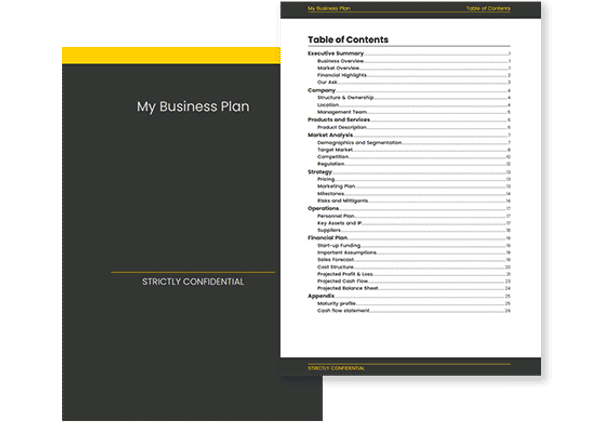
Using online business planning software is the most efficient and modern way to create a business plan that investors will trust.
There are several advantages to using specialized software:
- You can easily create your financial forecast by letting the software take care of the financial calculations for you without errors
- You are guided through the writing process by detailed instructions and examples for each part of the plan
- You can access a library of dozens of complete business plan samples and templates for inspiration
- You get a professional business plan, formatted and ready to be sent to your bank or investors
- You can easily track your actual financial performance against your financial forecast
- You can create scenarios to stress test your forecast's main assumptions
- You can easily update your forecast as time goes by to maintain visibility on future cash flows
- You have a friendly support team on standby to assist you when you are stuck
If you're interested in using this type of solution, you can try The Business Plan Shop for free by signing up here.
Hiring a business plan writer to write your business plan
Outsourcing your business plan to a business plan writer can also be a viable option.
These writers possess valuable experience in crafting business plans and creating accurate financial forecasts. Additionally, enlisting their services can save you precious time, enabling you to concentrate on the day-to-day operations of your business.
It's important to be mindful, though, that hiring business plan writers comes with a cost. You'll be paying not just for their time but also for the software they use, and their profit margin.
Based on experience, a complete business plan usually requires a budget of at least £1.5k ($2.0k) excluding tax, and more if revisions are needed after initial meetings with lenders or investors - changes often arise following these discussions.
When seeking investment, be cautious about spending too much on consulting fees. Investors prefer their funds to contribute directly to business growth. Thus, the amount you spend on business plan writing services and other consulting services should be negligible compared to the amount you raise.
Another aspect to consider is that while you'll receive the output of the business plan, you usually won't own the actual document. It will be saved in the consultant's business plan software, which will make updating the plan challenging without retaining the consultant on a retainer.
Given these factors, it's essential to carefully weigh the pros and cons of outsourcing your business plan to a business plan writer and decide what best suits your business's unique needs.
Why not create your business plan using Word or Excel?
Using Microsoft Excel and Word (or their Google, Apple, or open-source equivalents) to write a business plan is a terrible idea.
Why?
For starters, creating an accurate and error-free financial forecast on Excel (or any spreadsheet) is very technical and requires both a strong grasp of accounting principles and solid skills in financial modelling.
As a result, it is unlikely anyone will trust your numbers unless - like us at The Business Plan Shop - you hold a degree in finance and accounting and have significant financial modelling experience in your past.
The second reason is that it is inefficient. Building forecasts on spreadsheets was the only option in the 1990s and early 2000s, nowadays technology has advanced and software can do it much faster and much more accurately.
And with the rise of AI, software is also becoming smarter at helping us detect mistakes in our forecasts and helping us analyse the numbers to make better decisions.
Also, using software makes it easy to compare actuals vs. forecasts and maintain our forecasts up to date to maintain visibility on future cash flows - as we discussed earlier in this guide - whereas this is a pain to do with a spreadsheet.
That's for the forecast, but what about the written part of my business plan?
This part is less error-prone, but here also software brings tremendous gains in productivity:
- Word processors don't include instructions and examples for each part of your business plan
- Word processors don't update your numbers automatically when they change in your forecast
- Word processors don't handle the formatting for you
- ...
Overall, while Word or Excel may be viable options for creating a business plan for some entrepreneurs, it is by far not the best or most efficient solution.
Need a convincing business plan?
The Business Plan Shop makes it easy to create a financial forecast to assess the potential profitability of your projects, and write a business plan that’ll wow investors.
Where to find examples of market analysis in business plans
Below is an example of what the market analysis section of your business plan might look like. As you can see, it begins with the demographics and segmentation section that focuses on the domestic market.
As this example is for a coffee shop, there is a pie chart illustrating the share of the coffee shop market in France by brand in 2014.
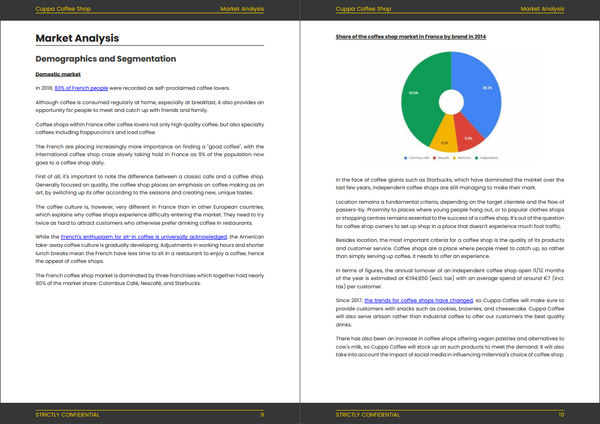
This example was taken from one of our business plan templates.
Errors to avoid when presenting your market analysis in your business plans
While market analysis is a critical component of any business plan, there are common errors that entrepreneurs should avoid when presenting their findings.
These errors can undermine the credibility of the analysis and hinder the effectiveness of the business plan. Here are some key mistakes to avoid:
Overlooking key data sources
Failing to gather comprehensive data or relying on outdated information can lead to incomplete or inaccurate market analysis. It's essential to utilize a variety of data sources and ensure that the information is current and relevant to the business's target market.
Ignoring competitive analysis
Neglecting to analyze competitors and market dynamics can result in missed opportunities and competitive threats. A thorough competitive analysis is essential for understanding the competitive landscape and identifying strategies to differentiate your business.
Lack of objectivity
Bias or preconceived notions can cloud judgment and skew the interpretation of market data. It's crucial to approach market analysis with objectivity and impartiality, allowing the data to drive decision-making rather than personal preferences or assumptions.
Overestimating market demand
Inflating market potential or failing to validate assumptions about customer demand can lead to unrealistic growth projections and misguided business strategies. It's important to conduct thorough market research and validate assumptions through customer feedback and market testing.
Need a convincing business plan?
The Business Plan Shop makes it easy to create a financial forecast to assess the potential profitability of your projects, and write a business plan that’ll wow investors.
Conclusion
Market analysis is a fundamental aspect of business planning that provides valuable insights to guide strategic decision-making and drive business success.
By effectively utilizing market analysis in business planning, entrepreneurs can identify opportunities, mitigate risks, and position their businesses for growth and profitability.
However, it's important to avoid common errors when presenting market analysis in business plans to ensure accuracy, credibility, and relevance. By following best practices and leveraging market analysis effectively, businesses can build a solid foundation for sustainable growth and long-term success.
Now you know how to do a market analysis for a business plan! I hope you found this guide useful. If so please share it, and if not let us know what we need to improve.
Also on The Business Plan Shop
- Free business plan template to download
- TAM SAM SOM, what it means and why it matters
- Business model vs business plan
- What is a business plan and how to create one?
- 3-year business plan template
- Business plan financial projections template
- Business plan vs business model canvas

Founder & CEO at The Business Plan Shop Ltd