How to write the personnel plan section of your business plan?

The personnel plan section of your business plan is where you will demonstrate to investors and potential business partners that your business is adequately staffed to execute its strategy.
In this guide, we will provide you with information you need in order to write an impactful presentation of your personnel plan in your business plan. You will learn about its key objectives, the essential information to include in this section, and guidelines on the ideal length of this segment.
Let’s begin!
What is the objective of the personnel plan subsection in your business plan?
The personnel plan subsection is a part of the overall operations section, which comes towards the end of your plan, just before the presentation of your financial plan. At this stage, the reader is, therefore, familiar with your business and your strategy for the years to come.
The key objectives of the personnel plan subsection of your business plan is to communicate to investors, lenders and strategic partners:
- Your business's staffing requirements, objectives, and strategies for effectively managing its workforce.
- How your business intends to attract and hire the necessary staff to accomplish the goals outlined in previous sections.
- The planned initiatives for training, developing, and retaining employees in order to ensure they are well-equipped to contribute to your business's success.
- How your business will address the potential risks associated with staffing or skill gaps.
Now that we understand the goals, let's have a look at the actual content of the personnel plan subsection.
Need a convincing business plan?
The Business Plan Shop makes it easy to create a financial forecast to assess the potential profitability of your projects, and write a business plan that’ll wow investors.
What information should I include in the personnel plan section of my business plan?
The level of details to include in your personnel plan will vary greatly based on the size of your business.
A small business with a handful of employees and limited recruitment plans will have a brief personnel plan. Whereas, a startup which plans to hire an extra 100 people over the next two years will need to provide more details. And so would a larger business with hundreds of staff.
Let's now explore in details what information to include in the personnel plan section of your business plan.
Introduce your team
Start by giving an overview of your current team and their qualifications, skills and experience.
Remember that the management team should have already been introduced in the presentation of the company earlier in your business plan.
Depending on the number of employees, you may want to include individual introductions. The introductions generally consist of a presentation of their role in your business, the employee's background, and a quick summary of why they are qualified to do the job.
To keep this section short, businesses with more than 10 employees can focus on introducing teams or divisions instead of individuals. Team introductions can include an overview of what the team does, an introduction of the manager, and the number of people in the team.
Highlight your staffing requirements
The next step is to explain your current and future staffing requirements.
Highlight the number and types of employees your business requires alongside the necessary qualifications, skills and experience.
Make sure you put this in the context of your business opening hours and operational organization. If relevant, explain how shifts work, if there are planned annual closures, etc.
In the staffing requirements subsection, you should also explain to the lenders or investors how your personnel plan aligns with your overall business strategy and objectives.
Investors or lenders reading your business plan should reach the conclusion that your staffing requirements are sufficient to run the business successfully and achieve its desired goals.
Need a convincing business plan?
The Business Plan Shop makes it easy to create a financial forecast to assess the potential profitability of your projects, and write a business plan that’ll wow investors.
Employee recruitment plan
The next step is to address any gaps in your current staffing levels, and/or explain how you will recruit the personnel needed to expand the business throughout the horizon of your business plan.
Start by identifying any gaps in your current team and state how your recruitment strategies will help you in mitigating these gaps.
Then, explain in detail how your business will attract top talent and what recruitment strategies you might employ (whether you will partner with employment agencies and headhunters, or simply use job boards and recruitment websites).
It is also useful to provide an overview of the phasing of your recruitments, especially if you are planning a large increase in staff in the future due to sales growth or opening multiple business branches. A quota per month or quarter is usually a good place to start.
It is also useful to describe in detail the employee compensation plans and benefits. Compensation plans should include comprehensive guidelines regarding employees' base salary, bonuses, and equity.
The benefits your staff members are going to avail while working in your company should also be mentioned in the personnel plan. For example, your business may be offering:
- Health benefits
- Retirement plan benefits
- Flexible work schedule
- Dental insurance
- Vision insurance
- Life insurance
- Paid family leave
Staff training and management plans
Finally, it is also useful to describe your staff training and management plans, especially if your business has to follow strict regulations (food or construction for example).
Start by explaining the goals and objectives of your staff training and management plans. What do you aim to achieve through training, and how does it align with your business objectives?
Continue by outlining the specific topics and skills that will be covered in your training programs. This could include technical skills, soft skills, compliance training, etc.
Then, describe the methods and modalities that will be used to deliver training, such as in-person workshops, online courses, on-the-job training, etc. Consider what approach will be most effective for your staff.
You can also provide a detailed schedule outlining when training sessions will take place, how long they will last, and any milestones or deadlines associated with the training program.
You will also need to identify the resources that will be needed to support the training program, such as training materials, equipment, trainers, etc. Also, consider any budgetary implications of the training plan.
You can also discuss how ongoing learning and development will be encouraged and supported within your organization beyond the initial training program. This could include opportunities for further education, skills development workshops, mentoring programs, etc.
It is also useful to explain what standard operating procedures you have in place, how these have been developed and how often they are reviewed.
And finally, finish by defining the key performance indicators (KPIs) that will be used to measure the success of your programs. This could include metrics such as employee satisfaction, productivity improvements, reduced turnover, etc.

What tools can you use to write your business plan
Using online business planning software is the most efficient and modern way to create a business plan.
There are several advantages to using specialized software:
- You can easily create your financial forecast by letting the software take care of the financial calculations for you without errors
- You are guided through the writing process by detailed instructions and examples for each part of the plan
- You can access a library of dozens of complete business plan samples and templates for inspiration
- You get a professional business plan, formatted and ready to be sent to your bank or investors
- You can easily track your actual financial performance against your financial forecast
- You can create scenarios to stress test your forecast's main assumptions
- You can easily update your forecast as time goes by to maintain visibility on future cash flows
- You have a friendly support team on standby to assist you when you are stuck
If you're interested in using this type of solution, you can try The Business Plan Shop for free by signing up here.
Do I need a personnel plan section if I don’t have any staff at the moment?
If you are a solopreneur, you still need to have a personnel plan section in your business plan. Having no staff, though, will change the information you need to include in it. Here is how to fill out a personnel plan if you do not have any staff at the moment:
Impact of solopreneurship on your business
Explain in detail how being a solopreneur with no employees will affect your business’s operations.
Aim to inform investors, lenders and other business partners how you possess all the necessary skills and qualifications to carry out the business plan and objectives effectively. Also highlight how the business will run if you have a medical emergency, sickness or if you go on holiday.
Future staffing requirements
As your business grows, you may need to hire staff to carry out its operations. Elaborate in the personnel plan when and why you may need to recruit staff in the future. Communicate to the investors that you have a plan in place for scaling your operations.
Your personnel plan must also include potential key roles and positions your business may require in the future. As your business expands, you should know the type of roles needed to keep it running smoothly.
Lastly, you need to describe in detail the skills, qualifications and experience required for the potential roles you have identified. Your personnel plan should clearly mention the criteria you wish to employ for staffing decisions.
Need a convincing business plan?
The Business Plan Shop makes it easy to create a financial forecast to assess the potential profitability of your projects, and write a business plan that’ll wow investors.
How long should the personnel plan section of your business plan be?
Personnel plan sections generally span 1-3 pages in a business plan. However, there are no hard and fast rules regarding its length. Multiple factors determine how long the personnel plan section of your business plan should be:
The most important factor to consider is the size of your business; some businesses are complex, having an elaborate team, vertical hierarchies, multiple compensation plans and recruitment strategies. The more employees your business has, the more information you will need to include regarding them in the personnel plan.
A small business with a handful of employees will have a more simple and precise personnel plan section.
The second factor to consider when deciding the length of your personnel plan is future recruitment. If your business is anticipating significant growth that will inevitably require you to recruit more staff members, your personnel plan will need to elaborate on the key roles and the necessary qualifications, skills and experience for those identified roles.
Example of the personnel plan section in a business plan
Below is an example of how the personnel plan section of your business plan might look like. As you can see, it is part of the operations section, which is just before the financial plan.
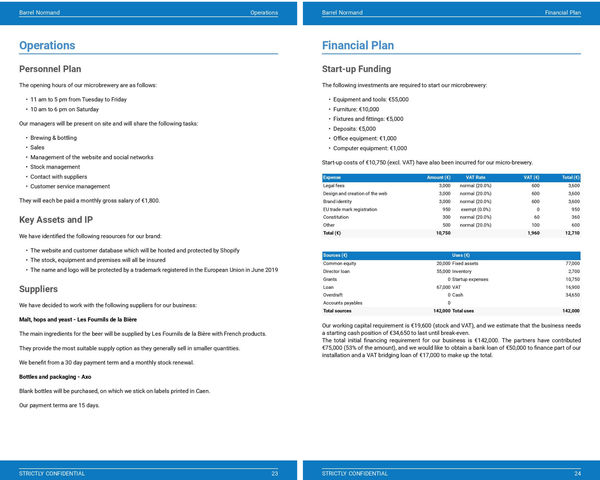
This example was taken from one of our business plan templates.
This is the end of our guide, we hope it helped you better understand how to write the personnel plan section of your business plan. Please don't hesitate to contact our friendly team if you have any questions of feedback.
Also on The Business Plan Shop
- How to write the risks and mitigants section of your business plan?
- Suppliers in business plan example
- Do I need a business plan?
- How to write the structure and ownership section of your business plan?
- Business plan cover page template and examples
- What should you include in your business plan appendices?
Know someone who needs to write a business plan? Share this guide with them!

Founder & CEO at The Business Plan Shop Ltd