The essential steps to writing a business plan for a bar

So that's it. You're dead set on swapping your nine to five in for a fast-paced lifestyle of sleek countertops, jazzy music, and colourful cocktails. In other words, you've decided to open your very own bar.
Although it's exciting, the road to opening a bar is a long and difficult one. To get the best chance possible, we recommend that you put your money on a business plan right from the start.
Luckily for you, we've got it covered!
From market research to creating a financial forecast, this in-depth guide walks you through all the steps needed to create a business plan for a bar.
Ready? Let's dive in!
The main objectives of a business plan for a bar
Let's explore the two key objectives that entrepreneurs usually have in mind when writing a business plan for their bar.
1. To find investors
Not every entrepreneur has the capital needed to kick-start a new business without a lending hand from the bank.
To obtain all the resources needed to open your bar, you'll have to convince bankers to finance part of your project. In an uncertain economic climate, this is no easy task.
You'll have to use your business plan to prove the viability of the project and your own credibility as an entrepreneur. The business plan for a bar is the document, upon after reading, investors will assess whether their own values and ambitions align with those of your project - and consequently, whether they're willing to provide financial support.
The business plan for a bar will also be used to facilitate credit and loan agreements, which prove useful in helping the business owner compensate for any unforeseen events that may impact the projected success of the business.
In addition, a bar business plan is a valuable tool for convincing investors of all kinds, from family and friends to angel investors, and for obtaining aid from local authorities.
2. To see the big picture of your business
The business plan for a bar or tavern is not only created for potential investors. Above all, it's addressed to you. Through the act of writing up the plan, you're obliged to understand, in detail, each aspect of your project in as realistic a way as possible.
The financial forecast for a bar is the section that potential investors will be most interested in. However, a well-designed bar business plan should cover each of the following topics:
- a description of your industry
- characteristics specific to your bar
- market research
- your pricing and marketing strategy
- your development plan
- your operational plan
Getting into the nitty-gritty of these sections will allow you to paint a clearer picture of what your business looks like - including the concept you've chosen for your bar, your resources, strengths, and weaknesses - to be able to adequately address any potential problems.
You can use these details to reflect on your business as its plan is being drafted - and adjust it accordingly in your bar business plan. And don't think for one second you'll be able to throw it away once you've finished using it to present to investors. It should be viewed as the roadmap of your project and a document you consult regularly to ensure that things are operating as they should be.
Need a convincing business plan?
The Business Plan Shop makes it easy to create a financial forecast to assess the potential profitability of your projects, and write a business plan that’ll wow investors.
Information needed to create a business plan for a bar
You need the right data in order to project sales, investments and costs accurately in the financial forecast of your bar business plan.
Below, we'll cover three key pieces of information you should gather before drafting your business plan.
Carrying out market research for a bar
Before you begin writing your business plan for a bar, conducting market research is a critical step in ensuring precise and realistic financial projections.
Market research grants you valuable insights into your target customer base, competitors, pricing strategies, and other crucial factors that can impact the success of your business.
In the course of this research, you may stumble upon trends that could impact your bar.
Market research may reveal that there is a growing demand for craft cocktails among your target demographic. This trend could suggest that incorporating more unique and high-quality cocktails into your menu may attract more customers and increase sales.
Another trend that market research might uncover is the popularity of social media among your target audience. This could indicate that implementing a strong social media presence for your bar, with visually appealing content and interactive promotions, could help attract and retain customers.
Such market trends play a pivotal role in revenue forecasting, as they provide essential data regarding potential customers' spending habits and preferences.
By integrating these findings into your financial projections, you can provide investors with more accurate information, enabling them to make well-informed decisions about investing in your bar.
Developing the sales and marketing plan for a bar
As you embark on creating your bar business plan, it is crucial to budget sales and marketing expenses beforehand.
A well-defined sales and marketing plan should include precise projections of the actions required to acquire and retain customers. It will also outline the necessary workforce to execute these initiatives and the budget required for promotions, advertising, and other marketing efforts.
This approach ensures that the appropriate amount of resources is allocated to these activities, aligning with the sales and growth objectives outlined in your business plan.
The staffing and equipment needs of a bar
As you embark on starting or expanding your bar, having a clear plan for recruitment and capital expenditures (investment in equipment and real estate) is essential for ensuring your business's success.
Both the recruitment and investment plans must align with the timing and level of growth projected in your forecast, and they require appropriate funding.
One possible staffing cost for a bar could be the wages of a bartender, which could range from $15-$25 per hour depending on experience and location. Other staffing costs may include the wages of servers, bussers, and security personnel.
Equipment costs for a bar may include purchasing and maintaining essential items such as bar stools, tables, glassware, and bar tools like shakers and strainers.
Additionally, the bar will need to invest in a variety of liquor, beer, and wine to stock their inventory, which can range from a few hundred dollars to thousands of dollars depending on the size and type of bar. Other equipment costs may include refrigerators, ice machines, and POS systems for tracking sales and inventory.
To create a realistic financial forecast, you also need to consider other operating expenses associated with the day-to-day running of your business, such as insurance and bookkeeping.
With all the necessary information at hand, you are ready to begin crafting your business plan and developing your financial forecast.

What goes into your bar's financial forecast?
The financial forecast of your bar's business plan will enable you to assess the growth, profitability, funding requirements, and cash generation potential of your business in the coming years.
The four key outputs of a financial forecast for a bar are:
- The profit and loss (P&L) statement,
- The projected balance sheet,
- The cash flow forecast,
- And the sources and uses table.
Let's look at each of these in a bit more detail.
The projected P&L statement
Your bar forecasted P&L statement enables the reader of your business plan to get an idea of how much revenue and profits your business is expected to make in the near future.
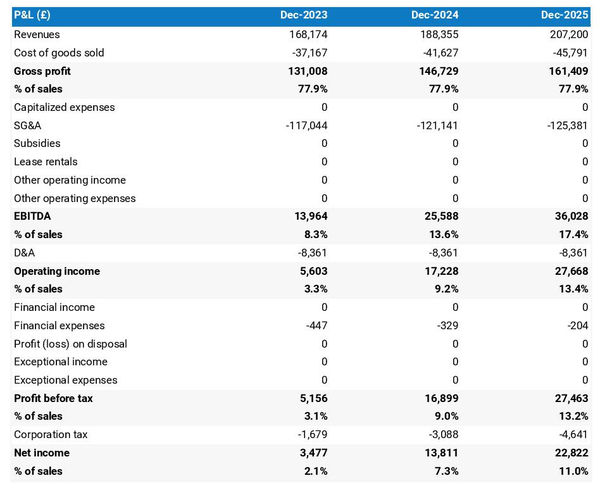
Ideally, your reader will want to see:
- Growth above the inflation level
- Expanding profit margins
- Positive net profit throughout the plan
Expectations for an established bar will of course be different than for a startup. Existing businesses which have reached their cruising altitude might have slower growth and higher margins than ventures just being started.
The forecasted balance sheet of your bar
The projected balance sheet of your bar will enable the reader of your business plan to assess the overall financial health of your business.
It shows three elements: assets, liabilities and equity:
- Assets: are productive resources owned by the business, such as equipment, cash, and accounts receivable (money owed by clients).
- Liabilities: are debts owed to creditors, lenders, and other entities, such as accounts payable (money owed to suppliers).
- Equity: includes the sums invested by the shareholders or business owners and the profits and losses accumulated by the business to date (which are called retained earnings). It is a proxy for the value of the owner's stake in the business.
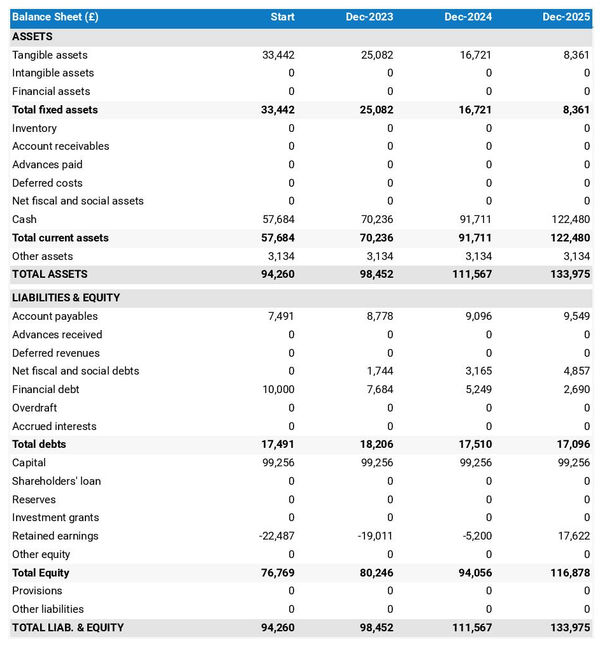
Analysing your bar projected balance sheet provides an understanding of your bar's working capital structure, investment and financing policies.
In particular, the readers of your plan can compare the level of financial debt on the balance sheet to the equity value to measure the level of financial risk (equity doesn't need to be reimbursed, while financial debt must be repaid, making it riskier).
They can also use your balance sheet to assess your bar's liquidity and solvency:
- A liquidity analysis: focuses on whether or not your business has sufficient cash and short-term assets to cover its liabilities due in the next 12 months.
- A solvency analysis: takes and longer view to assess whether or not your business has the capacity to repay its debts over the medium-term.
The cash flow forecast
As we've seen earlier in this guide, monitoring future cash flows is the key to success and the only way of ensuring that your bar has enough cash to operate.
As you can expect showing future cash flows is the main role of the cash flow forecast in your bar business plan.
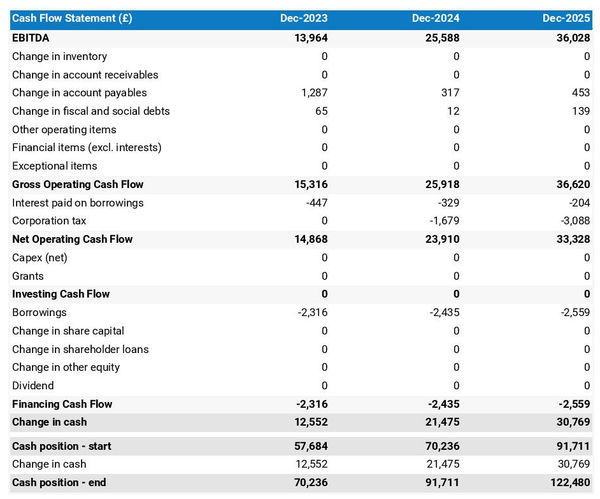
It is best practice to organise the cash flow statement by nature in order to show the cash impact of the following areas:
- Cash flow generated from operations: the operating cash flow shows how much cash is generated or consumed by the business's commercial activities
- Cash flow from investing activities: the investing cash flow shows how much cash is being invested in capital expenditure (equipment, real estate, etc.) either to maintain the business's equipment or to expand its capabilities
- Cash flow from financing activities: the financing cash flow shows how much cash is raised or distributed to financiers
Looking at the cash flow forecast helps you to make sure that your business has enough cash to keep running, and can help you anticipate potential cash shortfalls.
Your bar business plan will normally include both yearly and monthly cash flow forecasts so that the readers can view the impact of seasonality on your business cash position and generation.
The initial financing plan
The initial financing plan, also known as a sources and uses table, is a valuable resource to have in your business plan when starting your bar as it reveals the origins of the money needed to establish the business (sources) and how it will be allocated (uses).
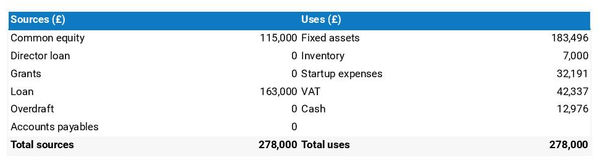
Having this table helps show what costs are involved in setting up your bar, how risks are shared between founders, investors and lenders, and what the starting cash position will be. This cash position needs to be sufficient to sustain operations until the business reaches a break-even point.
Now that you have a clear understanding of what goes into the financial forecast of your bar business plan, let's shift our focus to the written part of the plan.
Need a convincing business plan?
The Business Plan Shop makes it easy to create a financial forecast to assess the potential profitability of your projects, and write a business plan that’ll wow investors.
The written part of a bar or tavern business plan
The written part of a bar or tavern business plan plays a key role: it lays out the plan of action you intend to execute to seize the commercial opportunity you've identified on the market and provides the context needed for the reader to decide if they believe your plan to be achievable and your financial forecast to be realistic.
The written part of a bar business plan is composed of 7 main sections:
- The executive summary
- The presentation of the company
- The products and services
- The market analysis
- The strategy
- The operations
- The financial plan
Let's go through the content of each section in more detail!
1. The executive summary
In your bar's business plan, the first section is the executive summary — a captivating overview of your plan that aims to pique the reader's interest and leave them eager to learn more about your business.
When crafting the executive summary, start with an introduction to your business, including its name, concept, location, how long it has been running, and what sets it apart. Briefly mention the products and services you plan to offer and your target customer profile.
Following that, provide an overview of the addressable market for your bar, current trends, and potential growth opportunities.
Next, include a summary of key financial figures like projected revenues, profits, and cash flows.
Finally, in the "ask" section, detail any funding requirements you may have.
2. The presentation of the company
In your bar business plan, the second section should focus on the structure and ownership, location, and management team of your company.
In the structure and ownership part, you'll provide an overview of the business's legal structure, details about the owners, and their respective investments and ownership shares. This clarity is crucial, especially if you're seeking financing, as it helps the reader understand which legal entity will receive the funds and who controls the business.
Moving on to the location part, you'll offer an overview of the company's premises and their surroundings. Explain why this particular location is of interest, highlighting factors like catchment area, accessibility, and nearby amenities.
When describing the location of your bar to a potential third party financier, it is important to highlight the many benefits and opportunities that the location offers. Firstly, the location of your bar may provide a unique and diverse customer base. If it's in a central location and within proximity to various businesses, residential areas, and public transportation, your bar may attract a diverse mix of customers from different backgrounds and communities. This could potentially lead to a steady stream of customers and a loyal customer base.
Finally, you should introduce your management team. Describe each member's role, background, and experience.
Don't forget to emphasize any past successes achieved by the management team and how long they've been working together. Demonstrating their track record and teamwork will help potential lenders or investors gain confidence in their leadership and ability to execute the business plan.
3. The products and services section
The products and services section of your tavern business plan should include a detailed description of what your company sells to its customers.
For example, your bar might offer a variety of craft beers, signature cocktails, and wine options to cater to different tastes and preferences of your customers. This allows for a diverse and enjoyable drinking experience for your customers, and also sets your bar apart from others by offering unique and high-quality products.
Additionally, your bar might also offer small plates or appetizers to complement the drinks and enhance the overall dining experience for customers. This can help attract customers who are looking for a place to relax and socialize while enjoying a tasty bite to eat.
Lastly, your bar might offer live music or entertainment on certain nights to create a lively and fun atmosphere for customers, encouraging them to stay longer and potentially come back for future visits.
The reader will want to understand what makes your bar unique from other businesses in this competitive market.
When drafting this section, you should be precise about the categories of products or services you sell, the clients you are targeting and the channels that you are targeting them through.
4. The market analysis
When presenting your market analysis in your tavern business plan, you should detail the customers' demographics and segmentation, target market, competition, barriers to entry, and any regulations that may apply.
The goal of this section is to help the reader understand how big and attractive your market is, and demonstrate that you have a solid understanding of the industry.
You should start with the demographics and segmentation subsection, which gives an overview of the addressable market for your bar, the main trends in the marketplace, and introduces the different customer segments and their preferences in terms of purchasing habits and budgets.
The target market section should follow and zoom on the customer segments your bar is targeting, and explain how your products and services meet the specific needs of these customers.
For example, your target market might include young professionals in their 20s and 30s who are looking for a place to socialize and unwind after work. These individuals may have disposable income and are looking for a trendy and upscale atmosphere. They may also be interested in trying new craft beers and cocktails.
Then comes the competition subsection, where you should introduce your main competitors and explain what differentiates you from them.
Finally, you should finish your market analysis by giving an overview of the main regulations applicable to your bar.
5. The strategy section
When writing the strategy section of a business plan for your bar, it is essential to include information about your competitive edge, pricing strategy, sales & marketing plan, milestones, and risks and mitigants.
The competitive edge subsection should explain what sets your company apart from its competitors. This part is especially key if you are writing the business plan of a startup, as you have to make a name for yourself in the marketplace against established players.
The pricing strategy subsection should demonstrate how you intend to remain profitable while still offering competitive prices to your customers.
The sales & marketing plan should outline how you intend to reach out and acquire new customers, as well as retain existing ones with loyalty programs or special offers.
The milestones subsection should outline what your company has achieved to date, and its main objectives for the years to come - along with dates so that everyone involved has clear expectations of when progress can be expected.
The risks and mitigants subsection should list the main risks that jeopardize the execution of your plan and explain what measures you have taken to minimize these. This is essential in order for investors or lenders to feel secure in investing in your venture.
One example of a risk your bar may face is the potential for underage drinking. Despite strict laws and regulations, there is always a chance that someone under the legal drinking age may try to enter your establishment and consume alcohol. This could result in fines or even the loss of your liquor license if caught by authorities.
To mitigate this risk, it is important to have proper identification checks and strict policies in place to prevent underage individuals from accessing alcohol. Another risk that your bar could face is the possibility of a foodborne illness outbreak. Even with proper food safety protocols in place, there is always a chance that contaminated food could make its way onto your menu.
This could lead to customers getting sick and potentially damaging your reputation and business. To reduce this risk, it is important to regularly train and monitor your staff on proper food handling procedures and to have a system in place for quickly identifying and removing any potentially contaminated food items.
6. The operations section
The operations of your bar must be presented in detail in your business plan.
The first thing you should cover in this section is your staffing team, the main roles, and the overall recruitment plan to support the growth expected in your business plan. You should also outline the qualifications and experience necessary to fulfil each role, and how you intend to recruit (using job boards, referrals, or headhunters).
You should then state the operating hours of your bar - so that the reader can check the adequacy of your staffing levels - and any plans for varying opening times during peak season. Additionally, the plan should include details on how you will handle customer queries outside of normal operating hours.
The next part of this section should focus on the key assets and IP required to operate your business. If you depend on any licenses or trademarks, physical structures (equipment or property) or lease agreements, these should all go in there.
One key asset that your bar may have is the physical space itself. This could include the location, size, and layout of the bar. A prime location in a popular area could bring in a steady stream of customers, while a large and well-designed space could accommodate a larger crowd and potentially generate more revenue.
Additionally, your bar may have established relationships with suppliers and vendors, which could be considered another key asset. This could include agreements for exclusive products or discounted prices, giving your bar a competitive advantage over others in the area. These assets could contribute greatly to the success and profitability of your bar.
Finally, you should include a list of suppliers that you plan to work with and a breakdown of their services and main commercial terms (price, payment terms, contract duration, etc.). Investors are always keen to know if there is a particular reason why you have chosen to work with a specific supplier (higher-quality products or past relationships for example).
7. The presentation of the financial plan
The financial plan section is where we will include the financial forecast we discussed earlier in this guide.
Now that you have a clear idea of what goes into a bar business plan, let's look at some of the tools you can use to create yours efficiently.

What tool should I use to write my bar's business plan?
There are two main ways of creating your bar business plan:
- Using specialized business planning software,
- Hiring a business plan writer.
Using an online business plan software for your bar's business plan
Using online business planning software is the most efficient and modern way to create a bar business plan.
There are several advantages to using specialized software:
- You can easily create your financial forecast by letting the software take care of the financial calculations for you without errors
- You are guided through the writing process by detailed instructions and examples for each part of the plan
- You can access a library of dozens of complete business plan samples and templates for inspiration
- You get a professional business plan, formatted and ready to be sent to your bank or investors
- You can easily track your actual financial performance against your financial forecast
- You can create scenarios to stress test your forecast's main assumptions
- You can easily update your forecast as time goes by to maintain visibility on future cash flows
- You have a friendly support team on standby to assist you when you are stuck
If you're interested in using this type of solution, you can try The Business Plan Shop for free by signing up here.
Need a convincing business plan?
The Business Plan Shop makes it easy to create a financial forecast to assess the potential profitability of your projects, and write a business plan that’ll wow investors.
Hiring a business plan writer to write your bar or tavern business plan
Outsourcing your bar business plan to a business plan writer can also be a viable option.
Business plan writers are experienced in writing business plans and adept at creating financial forecasts without errors. Furthermore, hiring a consultant can save you time and allow you to focus on the day-to-day operations of your business.
However, hiring business plan writers is expensive as you are paying for the software used by the consultant, plus their time, and their profit margin of course.
From experience, you need to budget at least £1.5k ($2.0k) excluding tax for a complete business plan, more if you need to make changes after the initial version (which happens frequently after the initial meetings with lenders or investors).
You also need to be careful when seeking investment. Investors want their money to be used to grow the business, not spent on consulting fees. Therefore, the amount you spend on business plan writing services (and other consulting services such as legal services) needs to be negligible relative to the amount raised.
The other drawback is that you usually don't own the business plan itself: you just get the output, while the actual document is saved in the consultant's business plan software - which makes it difficult to maintain the document up to date without hiring the consultant on a retainer.
For these reasons, outsourcing the bar business plan to a business plan writer should be considered carefully, weighing both the advantages and disadvantages of hiring outside help.
Ultimately, it may be the right decision for some businesses, while others may find it beneficial to write their business plan using online software.
Why not create your bar or tavern business plan using Word or Excel?
Using Microsoft Excel and Word (or their Google, Apple, or open-source equivalents) to write a bar business plan is not advisable. Allow me to explain the reasons.
Firstly, creating an accurate and error-free financial forecast on Excel or any spreadsheet demands technical expertise in accounting principles and financial modelling. Without a degree in finance and accounting and significant financial modelling experience, it's unlikely that the reader will fully trust your numbers.
Secondly, relying on spreadsheets is inefficient. While it may have been the go-to option in the past, technology has evolved, and software now performs such tasks much faster and more accurately.
The second reason is that it is inefficient. Building forecasts on spreadsheets was the only option in the early 2000s, nowadays technology has advanced and software can do it much faster and much more accurately.
And with the rise of AI, software is also becoming smarter at helping us detect mistakes in our forecasts and helping us analyse the numbers to make better decisions.
Moreover, software offers ease in comparing actuals versus forecasts and maintaining up-to-date forecasts for clear visibility on future cash flows, as we discussed earlier in this guide. Such tasks are cumbersome when using spreadsheets.
Now, let's address the written part of your bar business plan. While it may be less prone to errors, using software can significantly boost productivity. Word processors lack instructions and examples for each section of your business plan. They also won't automatically update your numbers when changes occur in your forecast, and they lack automated formatting capabilities.
In summary, while some entrepreneurs may consider Word or Excel for their business plan, it's far from the best or most efficient solution when compared to specialized software.
Need a convincing business plan?
The Business Plan Shop makes it easy to create a financial forecast to assess the potential profitability of your projects, and write a business plan that’ll wow investors.
Bar business plan template
It's much easier to begin with a bar business plan example rather than a blank page - especially if you haven't drafted a business plan before.
Which is why you can draw inspiration from our bar business plan template to write your own plan in no time.
Our bar business plan template contains:
- A complete three-way financial forecast (P&L, balance sheet and cash flow forecast)
- A complete written business plan detailing all aspects of the company
Load the sample bar business plan template directly in our software and simply replace the text and numbers with your business' details to make it your own.
Takeaways
- Having an up-to-date business plan is key to maintaining visibility on your future cash flows.
- A business plan for a bar or tavern has 2 parts: a financial forecast highlighting the expected growth, profitability and cash generation of the business; and a written part which provides the context needed to interpret and assess the quality of the forecast.
- Using business plan software is the modern way of writing and maintaining business plans.
We hope that this guide helped you to better understand how to write the business plan for a bar. If you still have questions, do not hesitate to contact us.
Also on The Business Plan Shop:
- How to take over a bar
- Business plan template for a bar
- Open a craft beer bar
- Competitive edge in business plan example
- One-page business plan guide
- Key assumptions in your business plan example

Founder & CEO at The Business Plan Shop Ltd