How to write a business plan for a music label?

Putting together a business plan for a music label can be daunting - especially if you're creating a business for the first time - but with this comprehensive guide, you'll have the necessary tools to do it confidently.
We will explore why writing one is so important in both starting up and growing an existing music label, as well as what should go into making an effective plan - from its structure to content - and what tools can be used to streamline the process and avoid errors.
Without further ado, let us begin!
Why write a business plan for a music label?
Being clear on the scope and goals of the document will make it easier to understand its structure and content. So before diving into the actual content of the plan, let's have a quick look at the main reasons why you would want to write a music label business plan in the first place.
To have a clear roadmap to grow the business
It's rarely business as usual for small businesses. The economy follows cycles where years of growth are followed by recessions, and the business environment is always changing with new technologies, new regulations, new competitors, and new consumer behaviours appearing all the time...
In this context, running a business without a clear roadmap is like driving blindfolded: it's dangerous at best. That's why writing a business plan for a music label is essential to create successful and sustainable businesses.
To write an effective business plan, you will need to take stock of where you are (if you are already in business) and where you want the business to go in the next three to five years.
Once you know where you want your music label to be, you'll have to identify:
- what resources (human, equipment, and capital) are needed to get there,
- at what pace the business needs to progress to get there in time,
- and what risks you'll face along the way.
Going through this process regularly is beneficial, both for startups and existing companies, as it helps make informed decisions about how best to allocate resources to ensure the long-term success of the business.
To get visibility on future cash flows
If your small music label runs out of cash: it's game over. That's why we often say "cash is king", and it's crucial to have a clear view of your music label's future cash flows.
So, how can you achieve this? It's simple - you need to have an up-to-date financial forecast.
The good news is that your music label business plan already includes a financial forecast (which we'll discuss further in this guide). Your task is to ensure it stays current.
To accomplish this, it's essential to regularly compare your actual financial performance with what was planned in your financial forecast. Based on your business's current trajectory, you can make adjustments to the forecast.
By diligently monitoring your music label's financial health, you'll be able to spot potential financial issues, like unexpected cash shortfalls, early on and take corrective actions. Moreover, this practice will enable you to recognize and capitalize on growth opportunities, such as excess cash flow enabling you to expand to new locations.
To secure financing
Whether you are a startup or an existing business, writing a detailed music label business plan is essential when seeking financing from banks or investors.
This makes sense given what we've just seen: financiers want to ensure you have a clear roadmap and visibility on your future cash flows.
Banks will use the information included in the plan to assess your borrowing capacity (how much debt your business can support) and your ability to repay the loan before deciding whether they will extend credit to your business and on what terms.
Similarly, investors will review your plan carefully to assess if their investment can generate an attractive return on investment.
To do so, they will be looking for evidence that your music label has the potential for healthy growth, profitability, and cash flow generation over time.
Now that you understand why it is important to create a business plan for a music label, let's take a look at what information is needed to create one.
Need a convincing business plan?
The Business Plan Shop makes it easy to create a financial forecast to assess the potential profitability of your projects, and write a business plan that’ll wow investors.
Information needed to create a business plan for a music label
You need the right data in order to project sales, investments and costs accurately in the financial forecast of your music label business plan.
Below, we'll cover three key pieces of information you should gather before drafting your business plan.
Carrying out market research for a music label
Carrying out market research before writing a business plan for a music label is essential to ensure that the financial projections are accurate and realistic.
Market research helps you gain insight into your target customer base, competitors, pricing strategies and other key factors which can have an impact on the commercial success of your business.
In particular, it is useful in forecasting revenue as it provides valuable data regarding potential customers’ spending habits and preferences.
Your market research might reveal that the music market may be shifting towards more upbeat songs, or that listeners could be interested in music with a more experimental sound.
This information can then be used to create more accurate financial projections which will help investors make informed decisions about investing in your music label.
Developing the sales and marketing plan for a music label
As you embark on creating your music label business plan, it is crucial to budget sales and marketing expenses beforehand.
A well-defined sales and marketing plan should include precise projections of the actions required to acquire and retain customers. It will also outline the necessary workforce to execute these initiatives and the budget required for promotions, advertising, and other marketing efforts.
This approach ensures that the appropriate amount of resources is allocated to these activities, aligning with the sales and growth objectives outlined in your business plan.
The staffing and capital expenditure requirements of a music label
Whether you are starting or expanding a music label, it is important to have a clear plan for recruitment and capital expenditures (investment in equipment and real estate) in order to ensure the success of the business.
Both the recruitment and investment plans need to be coherent with the timing and level of growth planned in your forecast, and require appropriate funding.
The staffing costs for a music label may include hiring a team of music producers, sound engineers, marketing specialists, and administrative personnel. The equipment costs may include purchasing a mixing console, microphones, audio monitors, and other recording gear.
In order to create a realistic financial forecast, you will also need to consider the other operating expenses associated with running the business on a day-to-day basis (insurance, bookkeeping, etc.).
Once you have all the necessary information to create a business plan for your music label, it is time to start creating your financial forecast.
What goes into your music label's financial forecast?
The financial forecast of your music label's business plan will enable you to assess the growth, profitability, funding requirements, and cash generation potential of your business in the coming years.
The four key outputs of a financial forecast for a music label are:
- The profit and loss (P&L) statement,
- The projected balance sheet,
- The cash flow forecast,
- And the sources and uses table.
Let's look at each of these in a bit more detail.
The projected P&L statement
The projected P&L statement for a music label shows how much revenue and profit your business is expected to make in the future.
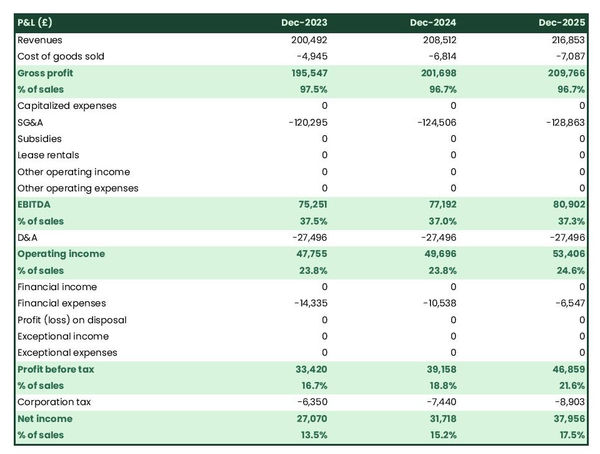
A healthy music label's P&L statement should show:
- Sales growing at (minimum) or above (better) inflation
- Stable (minimum) or expanding (better) profit margins
- A healthy level of net profitability
This will of course depend on the stage of your business: numbers for a startup will look different than for an established music label.
The forecasted balance sheet of your music label
The projected balance sheet of your music label will enable the reader of your business plan to assess the overall financial health of your business.
It shows three elements: assets, liabilities and equity:
- Assets: are productive resources owned by the business, such as equipment, cash, and accounts receivable (money owed by clients).
- Liabilities: are debts owed to creditors, lenders, and other entities, such as accounts payable (money owed to suppliers).
- Equity: includes the sums invested by the shareholders or business owners and the profits and losses accumulated by the business to date (which are called retained earnings). It is a proxy for the value of the owner's stake in the business.
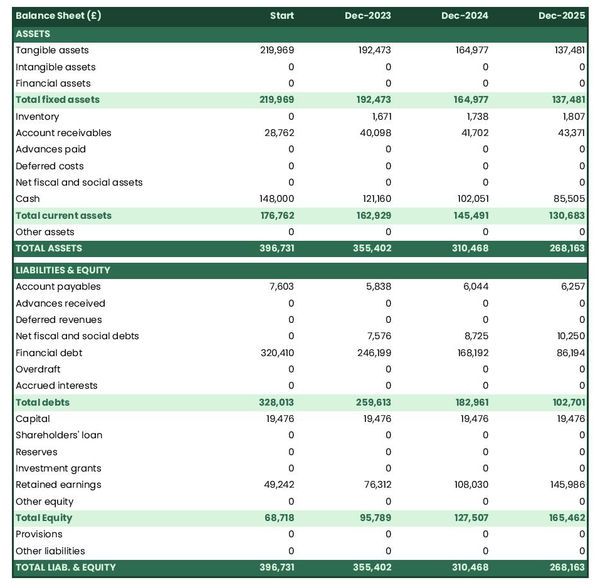
Analysing your music label projected balance sheet provides an understanding of your music label's working capital structure, investment and financing policies.
In particular, the readers of your plan can compare the level of financial debt on the balance sheet to the equity value to measure the level of financial risk (equity doesn't need to be reimbursed, while financial debt must be repaid, making it riskier).
They can also use your balance sheet to assess your music label's liquidity and solvency:
- A liquidity analysis: focuses on whether or not your business has sufficient cash and short-term assets to cover its liabilities due in the next 12 months.
- A solvency analysis: takes and longer view to assess whether or not your business has the capacity to repay its debts over the medium-term.
The cash flow forecast
A projected cash flow statement for a music label is used to show how much cash the business is generating or consuming.
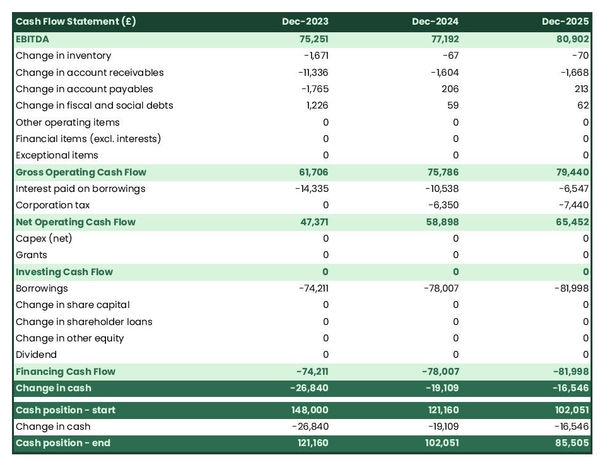
The cash flow forecast is usually organized by nature to show three key metrics:
- The operating cash flow: do the core business activities generate or consume cash?
- The investing cash flow: how much is the business investing in long-term assets (this is usually compared to the level of fixed assets on the balance sheet to assess whether the business is regularly maintaining and renewing its equipment)?
- The financing cash flow: is the business raising new financing or repaying financiers (debt repayment, dividends)?
As we discussed earlier, cash is king and keeping an eye on future cash flows an imperative for running a successful business. Therefore, you can expect the reader of your music label business plan to pay close attention to your cash flow forecast.
Also, note that it is customary to provide both yearly and monthly cash flow forecasts in a business plan - so that the reader can analyze seasonal variation and ensure the music label is appropriately funded.
The initial financing plan
The sources and uses table or initial financing plan is a key component of your business plan when starting a music label.
It shows where the capital needed to set up the business will come from (sources) and how it will be spent (uses).
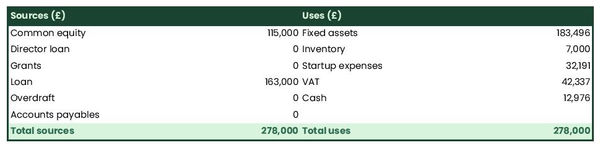
This table helps size the investment required to set up the music label, and understand how risks will be distributed between the business owners, and the financiers.
The sources and uses table also highlights what the starting cash position will be. This is key for startups as the business needs to have sufficient funding to sustain operations until the break-even point is reached.
Now that you have a clear understanding of what will go into the financial forecast of your music label business plan, let's have a look at the written part of the plan.
Need a convincing business plan?
The Business Plan Shop makes it easy to create a financial forecast to assess the potential profitability of your projects, and write a business plan that’ll wow investors.
The written part of a music label business plan
The written part of a music label business plan plays a key role: it lays out the plan of action you intend to execute to seize the commercial opportunity you've identified on the market and provides the context needed for the reader to decide if they believe your plan to be achievable and your financial forecast to be realistic.
The written part of a music label business plan is composed of 7 main sections:
- The executive summary
- The presentation of the company
- The products and services
- The market analysis
- The strategy
- The operations
- The financial plan
Let's go through the content of each section in more detail!
1. The executive summary
The executive summary, the first section of your music label's business plan, serves as an inviting snapshot of your entire plan, leaving readers eager to know more about your business.
To compose an effective executive summary, start with a concise introduction of your business, covering its name, concept, location, history, and unique aspects. Share insights about the services or products you intend to offer and your target customer base.
Subsequently, provide an overview of your music label's addressable market, highlighting current trends and potential growth opportunities.
Then, present a summary of critical financial figures, such as projected revenues, profits, and cash flows.
You should then include a summary of your key financial figures such as projected revenues, profits, and cash flows.
Lastly, address any funding needs in the "ask" section of your executive summary.
2. The presentation of the company
As you build your music label business plan, the second section deserves attention as it delves into the structure and ownership, location, and management team of your company.
In the structure and ownership part, you'll provide valuable insights into the legal structure of the business, the identities of the owners, and their respective investments and ownership stakes. This level of transparency is vital, particularly if you're seeking financing, as it clarifies which legal entity will receive the funds and who holds the reins of the business.
Moving to the location part, you'll offer a comprehensive view of the company's premises and articulate why this specific location is strategic for the business, emphasizing factors like catchment area, accessibility, and nearby amenities.
When describing the location of your music label, you may want to emphasize its potential for success. You could highlight its access to diverse talent pools, cultural resources, and cutting-edge technology. You might also point out its proximity to major cities, airports, and other important infrastructure. By emphasizing these factors, you could demonstrate to a third party financier that your music label is situated in a place that could be key to its long-term success.
Lastly, you should introduce your esteemed management team. Provide a thorough explanation of each member's role, background, and extensive experience.
It's equally important to highlight any past successes the management team has achieved and underscore the duration they've been working together. This information will instil trust in potential lenders or investors, showcasing the strength and expertise of your leadership team and their ability to deliver the business plan.
3. The products and services section
The products and services section of your business plan should include a detailed description of what your company offers, who are the target customers, and what distribution channels are part of your go-to-market.
For example, your music label might offer recording services to its customers, allowing them to record and produce their own music with the best quality equipment. It could also provide distribution services, allowing customers to reach a much larger audience than they would otherwise be able to. Lastly, it could offer marketing and promotional services, allowing customers to maximize the potential of their music and reach out to their desired audience.
4. The market analysis
When outlining your market analysis in the music label business plan, it's essential to include comprehensive details about customers' demographics and segmentation, target market, competition, barriers to entry, and relevant regulations.
The primary aim of this section is to give the reader an understanding of the market size and appeal while demonstrating your expertise in the industry.
To begin, delve into the demographics and segmentation subsection, providing an overview of the addressable market for your music label, key marketplace trends, and introducing various customer segments and their preferences in terms of purchasing habits and budgets.
Next, shift your focus to the target market subsection, where you can zoom in on the specific customer segments your music label targets. Explain how your products and services are tailored to meet the unique needs of these customers.
For example, your target market might include young adults between the ages of 18 and 24. This segment is highly active on social media and they like to stay up to date with the latest trends in music. They often attend concerts and purchase music from their favorite artists.
In the competition subsection, introduce your main competitors and explain what sets your music label apart from them.
Finally, round off your market analysis by providing an overview of the main regulations that apply to your music label.
5. The strategy section
When you write the strategy section of your music label business plan, remember to cover key elements such as your competitive edge, pricing strategy, sales & marketing plan, milestones, and risks and mitigants.
In the competitive edge subsection, elaborate on what makes your company stand out from competitors. This becomes especially important if you're a startup, aiming to carve a place for yourself amidst established players in the marketplace.
The pricing strategy subsection should demonstrate how you plan to maintain profitability while offering competitive prices to attract customers.
Outline your sales & marketing plan, detailing how you'll reach out to new customers and retain existing ones through loyalty programs or special offers.
For the milestones subsection, outline your company's achievements to date and your main objectives for the future, complete with specific dates to set clear expectations for progress.
Lastly, the risks and mitigants subsection should address the main risks that could affect your plan's execution. Explain the measures you've put in place to minimize these risks, assuring potential investors or lenders.
Your music label could face the risk of not being able to reach the target audience if the marketing strategy is not properly planned out. This could lead to losses in potential sales and revenue. Additionally, your music label could be exposed to the risk of piracy if the content is not properly secured. This could result in a loss of revenue due to the fact that people may not purchase the content if it is available for free.
6. The operations section
In your business plan, it's also essential to provide a detailed overview of the operations of your music label.
Start by covering your team, highlighting key roles and your recruitment plan to support the expected growth. Outline the qualifications and experience required for each role and your intended recruitment methods, whether through job boards, referrals, or headhunters.
Next, clearly state your music label's operating hours, allowing the reader to assess staffing levels adequately. Additionally, mention any plans for varying opening times during peak seasons and how you'll handle customer queries outside normal operating hours.
Then, shift your focus to the key assets and intellectual property (IP) necessary for your business. If you rely on licenses, trademarks, physical structures like equipment or property, or lease agreements, make sure to include them in this section.
You may have a variety of key assets and IP as a music label. For example, you could have exclusive contracts with certain artists that give you the right to produce and distribute their music. Additionally, you might own the copyright to a variety of songs, which could give you the exclusive right to produce and distribute those songs.
Lastly, include a list of suppliers you plan to work with, detailing their services and main commercial terms, such as price, payment terms, and contract duration. Investors are interested in understanding why you've chosen specific suppliers, which may be due to higher-quality products or established relationships from previous ventures.
7. The presentation of the financial plan
The financial plan section is where we will include the financial forecast we talked about earlier in this guide.
Now that you have a clear idea of the content of a music label business plan, let's look at some of the tools you can use to create yours.
What tool should I use to write my music label's business plan?
In this section, we will be reviewing the two main solutions for creating a music label business plan:
- Using specialized online business plan software,
- Outsourcing the plan to the business plan writer.
Using an online business plan software for your music label's business plan
Using online business planning software is the most efficient and modern way to create a music label business plan.
There are several advantages to using specialized software:
- You can easily create your financial forecast by letting the software take care of the financial calculations for you without errors
- You are guided through the writing process by detailed instructions and examples for each part of the plan
- You can access a library of dozens of complete business plan samples and templates for inspiration
- You get a professional business plan, formatted and ready to be sent to your bank or investors
- You can easily track your actual financial performance against your financial forecast
- You can create scenarios to stress test your forecast's main assumptions
- You can easily update your forecast as time goes by to maintain visibility on future cash flows
- You have a friendly support team on standby to assist you when you are stuck
If you're interested in using this type of solution, you can try The Business Plan Shop for free by signing up here.
Need a convincing business plan?
The Business Plan Shop makes it easy to create a financial forecast to assess the potential profitability of your projects, and write a business plan that’ll wow investors.
Hiring a business plan writer to write your music label's business plan
Outsourcing your music label business plan to a business plan writer can also be a viable option.
Business plan writers are skilled in creating error-free business plans and accurate financial forecasts. Moreover, hiring a consultant can save you valuable time, allowing you to focus on day-to-day business operations.
However, it's essential to be aware that hiring business plan writers will be expensive, as you're not only paying for their time but also the software they use and their profit margin.
Based on experience, you should budget at least £1.5k ($2.0k) excluding tax for a comprehensive business plan, and more if you require changes after initial discussions with lenders or investors.
Also, exercise caution when seeking investment. Investors prefer their funds to be directed towards business growth rather than spent on consulting fees. Therefore, the amount you spend on business plan writing services and other consulting services should be insignificant compared to the amount raised.
Keep in mind that one drawback is that you usually don't own the business plan itself; you only receive the output, while the actual document is saved in the consultant's business planning software. This can make it challenging to update the document without retaining the consultant's services.
For these reasons, carefully consider outsourcing your music label business plan to a business plan writer, weighing the advantages and disadvantages of seeking outside assistance.
Why not create your music label's business plan using Word or Excel?
Using Microsoft Excel and Word (or their Google, Apple, or open-source equivalents) to write a music label business plan is a terrible idea.
Why?
For starters, creating an accurate and error-free financial forecast on Excel (or any spreadsheet) is very technical and requires both a strong grasp of accounting principles and solid skills in financial modelling.
As a result, it is unlikely anyone will trust your numbers unless - like us at The Business Plan Shop - you hold a degree in finance and accounting and have significant financial modelling experience in your past.
The second reason is that it is inefficient. Building forecasts on spreadsheets was the only option in the 1990s and early 2000s, nowadays technology has advanced and software can do it much faster and much more accurately.
And with the rise of AI, software is also becoming smarter at helping us detect mistakes in our forecasts and helping us analyse the numbers to make better decisions.
Also, using software makes it easy to compare actuals vs. forecasts and maintain our forecasts up to date to maintain visibility on future cash flows - as we discussed earlier in this guide - whereas this is a pain to do with a spreadsheet.
That's for the forecast, but what about the written part of my music label business plan?
This part is less error-prone, but here also software brings tremendous gains in productivity:
- Word processors don't include instructions and examples for each part of your business plan
- Word processors don't update your numbers automatically when they change in your forecast
- Word processors don't handle the formatting for you
- ...
Overall, while Word or Excel may be viable options for creating a music label business plan for some entrepreneurs, it is by far not the best or most efficient solution.
Takeaways
- Using business plan software is a modern and cost-effective way of writing and maintaining business plans.
- A business plan is not a one-shot exercise as maintaining it current is the only way to keep visibility on your future cash flows.
- A business plan has 2 main parts: a financial forecast outlining the funding requirements of your music label and the expected growth, profits and cash flows for the next 3 to 5 years; and a written part which gives the reader the information needed to decide if they believe the forecast is achievable.
We hope that this in-depth guide met your expectations and that you now have a clear understanding of how to write your music label business plan. Do not hesitate to contact our friendly team if you have questions additional questions we haven't addressed here.
Also on The Business Plan Shop
- How to write a business plan to secure a bank loan?
- When to call in a business plan writer?
- How to write the structure and ownership section of your business plan?
- Business plan cover page tips
- Key steps to write a business plan?
- Top mistakes to avoid in your business plan
Do you know entrepreneurs interested in starting or growing a music label? Share this article with them!

Founder & CEO at The Business Plan Shop Ltd