How to create a financial forecast for a road-safety testing center?
Developing and maintaining an up-to-date financial forecast for your road-safety testing center is key in order to maintain visibility on your business’s future cash flows.
If you feel overwhelmed at the thought of putting together a road-safety testing center financial forecast then don’t worry as this guide is here to help you.
We'll cover everything from: the main objectives of a financial forecast, the data you need to gather before starting, to the tables that compose it, and the tools that will help you create and maintain your forecast efficiently.
Let's get started!
Why create and maintain a financial forecast for a road-safety testing center?
The financial projections for your road-safety testing center act as a financial blueprint to guide its growth with confidence and ensure its long-term financial viability.
To create them, you will need to look at your business in detail - from sales to operating costs and investments - to assess how much profit it can generate in the years to come and what will be the associated cash flows.
During challenging market conditions, maintaining an up-to-date financial forecast enables early detection of potential financial shortfalls, allowing for timely adjustments or securing financing before facing a cash crisis.
Your road-safety testing center's financial forecast will also prove invaluable when seeking financing. Banks and investors will undoubtedly request a thorough examination of your financial figures, making precision and presentation essential.
Need a convincing business plan?
The Business Plan Shop makes it easy to create a financial forecast to assess the potential profitability of your projects, and write a business plan that’ll wow investors.
What information is used as input to build a road-safety testing center financial forecast?
A road-safety testing center's financial forecast is only as good as the inputs used to build it.
If you are creating (or updating) the forecast of an existing road-safety testing center, then you mostly need your accounting information, key historical operating non-financial data, and your team’s input on what to expect for the coming years.
If you are building financial projections for a road-safety testing center startup, you will need to have done your research and have a clear picture of your competitive environment and go-to-market strategy so that you can forecast sales accurately.
For a new venture, you will also need a precise list of the resources needed to keep the road-safety testing center running on a day-to-day basis and a list of the equipment and expenditures required to start the business (more on that later).
Let's now take a closer look at the elements that make up your road-safety testing center's financial forecast.
The sales forecast for a road-safety testing center
The sales forecast, also called topline projection, is normally where you will start when building your road-safety testing center financial forecast.
Creating a coherent sales projection boils down to estimating two key drivers:
- The average price
- The number of monthly transactions
To do this, you will need to rely on historical data (for an existing business), market research data (for both new and existing road-safety testing centers), and consider the elements below:
- Increasing government regulations on vehicle safety standards may lead to a higher demand for road-safety testing services, resulting in an increase in average price per transaction.
- The introduction of new technology in the automotive industry, such as self-driving cars, may decrease the need for traditional road-safety testing services, resulting in a decrease in the number of monthly transactions.
- Unfavorable weather conditions, such as heavy rain or snow, may lead to an increase in accidents and a higher demand for road-safety testing services, resulting in an increase in the number of monthly transactions.
- The opening of a new road-safety testing center in the same area may lead to increased competition and potentially lower prices, resulting in a decrease in average price per transaction.
- An increase in gas prices may lead to a decrease in the number of people driving and therefore, a decrease in the demand for road-safety testing services, resulting in a decrease in the number of monthly transactions.
After the sales forecast comes the operating expenses budget, which we will now look into in more detail.
Need a convincing business plan?
The Business Plan Shop makes it easy to create a financial forecast to assess the potential profitability of your projects, and write a business plan that’ll wow investors.
The operating expenses for a road-safety testing center
The next step is to estimate the costs you’ll have to incur to operate your road-safety testing center.
These will vary based on where your business is located, and its overall size (level of sales, personnel, etc.).
But your road-safety testing center's operating expenses should normally include the following items:
- Staff costs: This includes salaries, benefits, and training for employees such as testers, engineers, and administrative staff.
- Accountancy fees: You will need to hire an accountant to manage the financial records and tax filings for your road-safety testing center.
- Insurance costs: As a road-safety testing center, you will need to have liability insurance to protect against any potential accidents or damages during testing.
- Software licenses: You will need to purchase licenses for software programs used for data analysis, simulations, and other testing processes.
- Banking fees: Your road-safety testing center will have banking fees associated with transaction fees, wire transfers, and account maintenance.
- Rent: You will need to pay for a facility to conduct your testing, whether it is a dedicated building or a space within a larger facility.
- Utilities: This includes electricity, water, and other necessary utilities for your testing center.
- Equipment maintenance: You will need to regularly maintain and service testing equipment to ensure accurate and safe results.
- Marketing and advertising: To attract clients and promote your services, you may need to invest in marketing and advertising efforts.
- Professional fees: You may need to hire outside consultants or experts for specialized testing or analysis.
- Travel expenses: If you need to conduct testing at various locations, you will need to budget for travel expenses such as transportation and accommodations.
- Office supplies: This includes necessary supplies such as paper, printer ink, and other office materials.
- Training and development: To stay updated on industry standards and regulations, you may need to invest in training and development for your employees.
- Safety equipment: As a road-safety testing center, it is important to have safety equipment such as helmets, gloves, and goggles for your employees.
- Legal fees: You may need to seek legal advice and services for contracts, liability waivers, and other legal matters related to your testing center.
This list is not exhaustive by any means, and will need to be tailored to your road-safety testing center's specific circumstances.
What investments are needed to start or grow a road-safety testing center?
Once you have an idea of how much sales you could achieve and what it will cost to run your road-safety testing center, it is time to look into the equipment required to launch or expand the activity.
For a road-safety testing center, capital expenditures and initial working capital items could include:
- Testing Equipment: This includes any equipment necessary for conducting road-safety tests, such as braking systems, crash test dummies, and speedometers.
- Facility Upgrades: In order to meet safety standards and regulations, you may need to make upgrades to your testing center's facilities, such as installing safety barriers, upgrading lighting, or adding ventilation systems.
- Vehicle Fleet: In order to conduct tests, you will need a fleet of vehicles available for use. This could include cars, trucks, motorcycles, and other vehicles necessary for testing different scenarios.
- Computer Software and Hardware: To analyze test results and keep records, you will need computers, software, and data storage capabilities specifically designed for road-safety testing.
- Safety Gear: In order to ensure the safety of your test drivers and employees, you may need to invest in safety gear such as helmets, seat belts, and protective clothing.
Again, this list will need to be adjusted according to the specificities of your road-safety testing center.
Need a convincing business plan?
The Business Plan Shop makes it easy to create a financial forecast to assess the potential profitability of your projects, and write a business plan that’ll wow investors.
The financing plan of your road-safety testing center
The next step in the creation of your financial forecast for your road-safety testing center is to think about how you might finance your business.
You will have to assess how much capital will come from shareholders (equity) and how much can be secured through banks.
Bank loans will have to be modelled so that you can separate the interest expenses from the repayments of principal, and include all this data in your forecast.
Issuing share capital and obtaining a bank loan are two of the most common ways that entrepreneurs finance their businesses.
What tables compose the financial plan for a road-safety testing center?
Now let's have a look at the main output tables of your road-safety testing center's financial forecast.
The forecasted profit & loss statement
The profit & loss forecast gives you a clear picture of your business’ expected growth over the first three to five years, and whether it’s likely to be profitable or not.
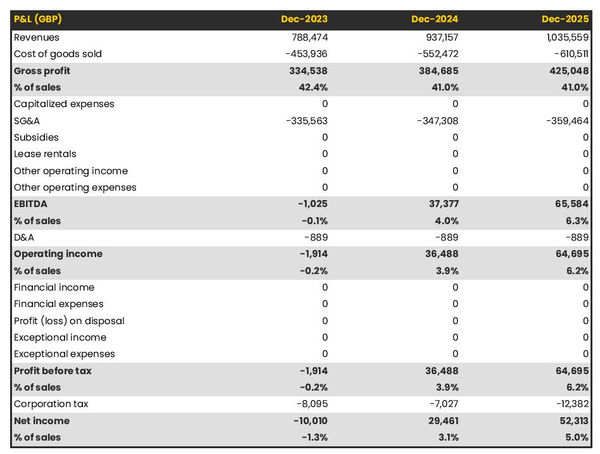
A healthy road-safety testing center's P&L statement should show:
- Sales growing at (minimum) or above (better) inflation
- Stable (minimum) or expanding (better) profit margins
- A healthy level of net profitability
This will of course depend on the stage of your business: numbers for an established road-safety testing center will look different than for a startup.
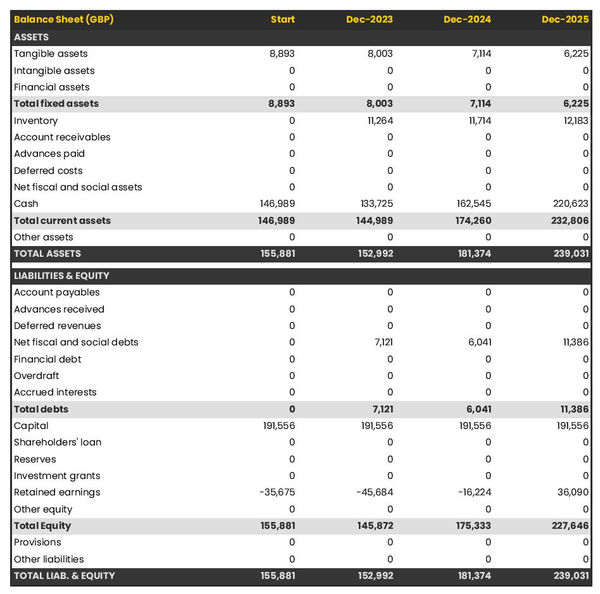
The projected balance sheet
Your road-safety testing center's forecasted balance sheet enables you to assess your financial structure and working capital requirements.
It is composed of three types of elements: assets, liabilities and equity:
- Assets: represent what the business owns and uses to produce cash flows. It includes resources such as cash, equipment, and accounts receivable (money owed by clients).
- Liabilities: represent funds advanced to the business by lenders and other creditors. It includes items such as accounts payable (money owed to suppliers), taxes due and loans.
- Equity: is the combination of what has been invested by the business owners and the cumulative profits and losses generated by the business to date (which are called retained earnings). Equity is a proxy for the value of the owner's stake in the business.
The cash flow forecast
Your road-safety testing center's cash flow forecast shows how much cash your business is expected to consume or generate in the years to come.
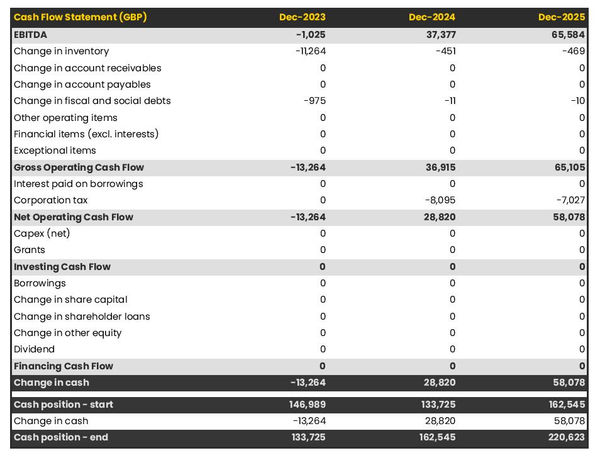
It is best practice to organise the cash flow forecast by nature to better explain where cash is used or generated by the road-safety testing center:
- Operating cash flow: shows how much cash is generated by the operating activities
- Investing cash flow: shows how much will be invested in capital expenditure to maintain or expand the business
- Financing cash flow: shows if the business is raising new capital or repaying financiers (debt repayment, dividends)
Keeping an eye on (and regularly updating) your road-safety testing center's cash flow forecast is key to ensuring that your business has sufficient liquidity to operate normally and to detect financing requirements as early as possible.
If you are trying to raise capital, you will normally be asked to provide a monthly cash flow forecast in your road-safety testing center's financial plan - so that banks or investors can assess seasonal variation and ensure your business is appropriately capitalised.
Need a convincing business plan?
The Business Plan Shop makes it easy to create a financial forecast to assess the potential profitability of your projects, and write a business plan that’ll wow investors.
Which tool should you use to create your road-safety testing center's financial forecast?
Using the right tool or solution will make the creation of your road-safety testing center's financial forecast much easier than it sounds. Let’s explore the main options.
Using online financial projection software to build your road-safety testing center's forecast
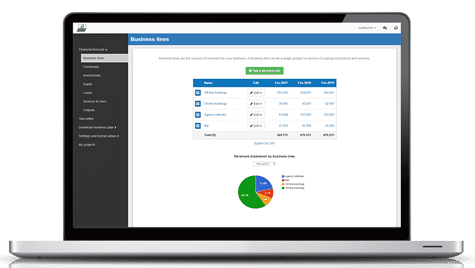
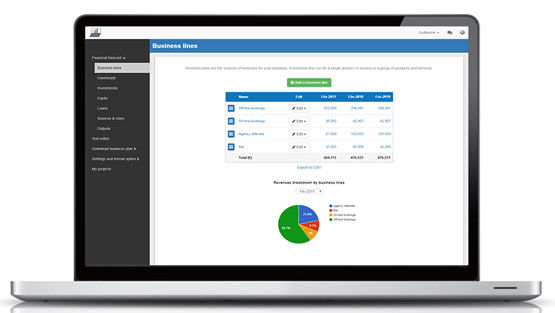
The modern and easiest way to build a forecast is to use professional financial projection software such as the one we offer at The Business Plan Shop.
There are several advantages to using specialised software:
- You can easily create your financial forecast by letting the software take care of the financial calculations for you without errors
- You have access to complete financial forecast templates
- You get a complete financial forecast ready to be sent to your bank or investors
- You can easily track your actual financial performance against your financial forecast, and recalibrate your forecast as the year goes by
- You can create scenarios to stress test your forecast's main assumptions
- You can easily update your forecast as time goes by to maintain visibility on future cash flows
- You have a friendly support team on standby to assist you when you are stuck
- It’s cost-efficient and much cheaper than using an accountant or consultant (see below)
If you are interested in this type of solution, you can try our forecasting software for free by signing up here.
Calling in a financial consultant or chartered accountant
Enlisting the help of a consultant or accountant is also a good way to obtain a professional road-safety testing center financial forecast.
The downside of this solution is its cost. From experience, obtaining a simple financial forecast over three years (including a balance sheet, income statement, and cash flow statement) is likely to cost a minimum of £700 or $1,000.
The indicative cost above, is for a small business, and a forecast is done as a one-shot exercise. Using a consultant or accountant to track your actuals vs. forecast and to keep your financial projections up to date on a monthly or quarterly basis will cost a lot more.
If you opt for this solution, make sure your accountant has in-depth knowledge of your industry, so that they may challenge your figures and offer insights (as opposed to just taking your assumptions at face value to create the forecast).
Why not use a spreadsheet such as Excel or Google Sheets to build your road-safety testing center's financial forecast?
You and your financial partners need numbers you can trust. Unless you have studied finance or accounting, creating a trustworthy and error-free road-safety testing center financial forecast on a spreadsheet is likely to prove challenging.
Financial modelling is very technical by nature and requires a solid grasp of accounting principles to be done without errors. This means that using spreadsheet software like Excel or Google Sheets to create accurate financial forecasts is out of reach for most business owners.
Creating forecasts in Excel is also inefficient nowadays:
- Software has advanced to the point where forecasting can be done much faster and more accurately than manually on a spreadsheet.
- With artificial intelligence, the software is capable of detecting mistakes and helping decision-making.
Spreadsheets are versatile tools but they are not tailor-made for reporting. Importing your road-safety testing center's accounting data in Excel to track actual vs. forecast is incredibly manual and tedious (and so is keeping forecasts up to date). It is much faster to use dedicated financial planning tools like The Business Plan Shop which are built specially for this.
Need a convincing business plan?
The Business Plan Shop makes it easy to create a financial forecast to assess the potential profitability of your projects, and write a business plan that’ll wow investors.
Use our financial projection templates for inspiration
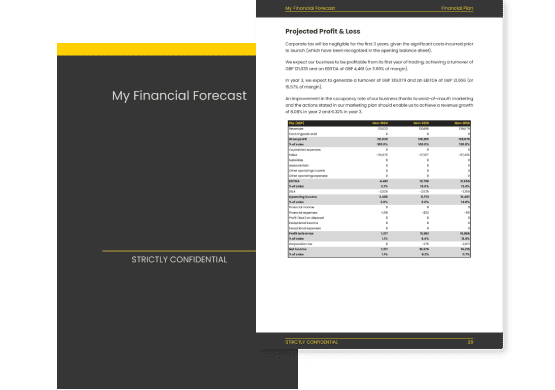
The Business Plan Shop has dozens of financial forecast templates available.
Our examples contain a complete business plan with a financial forecast and a written presentation of the company, the team, the strategy, and the medium-term objectives.
Whether you are just starting out or already have your own road-safety testing center, looking at our financial forecast template is a good way to:
- Understand what a complete business plan should look like
- Understand how you should model financial items for your road-safety testing center
Takeaways
- Having a financial forecast enables you to visualise the expected growth, profitability, and cash generation for your business over the next three to five years.
- Tracking actuals vs. forecast and keeping your financial projections up-to-date is the only way to get a view on what your road-safety testing center future cash flows may look like.
- Using financial forecasting software is the mordern and easy way to create and maintain your forecasts.
This is the end of our guide on how to build the financial forecast for a road-safety testing center, we hope you found it useful. Don't hesitate to contact us if you want to share your feedback or have any questions.
Need a convincing business plan?
The Business Plan Shop makes it easy to create a financial forecast to assess the potential profitability of your projects, and write a business plan that’ll wow investors.
Also on The Business Plan Shop
- Example of financial forecast
- How to create a sales forecast for a business?
- Financial forecast for a business idea
Know someone who owns or is thinking of starting a road-safety testing center? Share our forecasting guide with them!

Founder & CEO at The Business Plan Shop Ltd