How to create a financial forecast for a risk assessment company?
If you are serious about keeping visibility on your future cash flows, then you need to build and maintain a financial forecast for your risk assessment company.
Putting together a risk assessment company financial forecast may sound complex, but don’t worry, with the right tool, it’s easier than it looks, and The Business Plan Shop is here to guide you.
In this practical guide, we'll cover everything you need to know about building financial projections for your risk assessment company.
We will start by looking at why they are key, what information is needed, what a forecast looks like once completed, and what solutions you can use to create yours.
Let's dive in!
Why create and maintain a financial forecast for a risk assessment company?
The financial projections for your risk assessment company act as a financial blueprint to guide its growth with confidence and ensure its long-term financial viability.
To create them, you will need to look at your business in detail - from sales to operating costs and investments - to assess how much profit it can generate in the years to come and what will be the associated cash flows.
During challenging market conditions, maintaining an up-to-date financial forecast enables early detection of potential financial shortfalls, allowing for timely adjustments or securing financing before facing a cash crisis.
Your risk assessment company's financial forecast will also prove invaluable when seeking financing. Banks and investors will undoubtedly request a thorough examination of your financial figures, making precision and presentation essential.
Need a convincing business plan?
The Business Plan Shop makes it easy to create a financial forecast to assess the potential profitability of your projects, and write a business plan that’ll wow investors.
What information is needed to build a risk assessment company financial forecast?
The quality of your inputs is key when it comes to financial modelling: no matter how good the model is, if your inputs are off, so will the forecast.
If you are building a financial plan to start a risk assessment company, you will need to have done your market research and have a clear picture of your sales and marketing strategies so that you can project revenues with confidence.
You will also need to have a clear idea of what resources will be required to operate the risk assessment company on a daily basis, and to have done your research with regard to the equipment needed to launch your venture (see further down this guide).
If you are creating a financial forecast of an existing risk assessment company, things are usually simpler as you will be able to use your historical accounting data as a budgeting base, and complement that with your team’s view on what lies ahead for the years to come.
Let's now zoom in on what will go in your risk assessment company's financial forecast.
The sales forecast for a risk assessment company
From experience, it usually makes sense to start your risk assessment company's financial projection with the revenues forecast.
The inputs used to forecast your sales will include the historical trading data of your risk assessment company (which can be used as a starting point for existing businesses) and the data collected in your market research (which both new ventures and existing businesses need to project their sales forward).
Your risk assessment company's sales forecast can be broken down into two key estimates:
- The average price
- The number of monthly transactions
To assess these variables accurately, you will need to consider the following factors:
- Environmental regulations: As more and more countries and organizations become aware of the importance of risk assessment, there may be an increase in regulations that require companies to conduct regular risk assessments. This could lead to an increase in demand for our services, driving up our average price and number of transactions.
- Technological advancements: The field of risk assessment is constantly evolving, with new technologies being developed to improve the accuracy and efficiency of the process. If we are able to stay at the forefront of these advancements and offer cutting-edge services, we may be able to command a higher average price and attract more clients.
- Industry trends: As the demand for risk assessment services grows, it is likely that new competitors will enter the market. This could lead to increased competition and potentially drive down our average price. However, if we are able to differentiate ourselves and maintain a strong reputation, we may be able to maintain or even increase our average price.
- Economic conditions: The state of the economy can also have a significant impact on our business. During times of economic downturn, companies may be more reluctant to invest in risk assessment services, leading to a decrease in our number of monthly transactions. On the other hand, during periods of economic growth, there may be an increase in businesses seeking to expand and therefore in need of risk assessment services.
- Natural disasters: Unfortunately, natural disasters can also have a significant impact on our business. As the frequency and severity of natural disasters increase, there may be a higher demand for risk assessment services from companies looking to mitigate potential risks. This could lead to an increase in both our average price and number of monthly transactions.
Once you have a sales forecast in place, the next step will be to work on your overhead budget. Let’s have a look at that now.
Need a convincing business plan?
The Business Plan Shop makes it easy to create a financial forecast to assess the potential profitability of your projects, and write a business plan that’ll wow investors.
The operating expenses for a risk assessment company
Once you know what level of sales you can expect, you can start budgeting the expenses required to operate your risk assessment company on a daily basis.
Expenses normally vary based on how much revenue you anticipate (which is why, from experience, it is always better to start your forecast with the topline projection), and where your business is based.
Operating expenses for a risk assessment company will include some of the following items:
- Staff Costs: This includes salaries, benefits, and any other expenses related to employees such as training and development.
- Accountancy Fees: As a risk assessment company, you will need to hire an accountant to ensure accurate financial records and to prepare tax returns.
- Insurance Costs: This includes liability insurance, professional indemnity insurance, and any other insurance policies necessary to protect your business from potential risks.
- Software Licences: You will need to purchase and renew software licences for any risk assessment tools or software that your company uses.
- Banking Fees: This includes fees for maintaining a business bank account, wire transfers, and any other banking services.
- Rent/Mortgage: If you have a physical office space, you will need to include the cost of rent or mortgage payments in your operating expenses.
- Utilities: This includes electricity, water, and internet services for your office.
- Marketing and Advertising: As a risk assessment company, you will need to invest in marketing and advertising to attract clients and promote your services.
- Travel Expenses: This includes any travel expenses related to meeting with clients or attending conferences and events.
- Office Supplies: You will need to purchase office supplies such as stationary, printer ink, and other necessary items to run your business.
- Professional Memberships: As a risk assessment company, it may be beneficial to join professional associations or organizations for networking and staying up-to-date with industry trends.
- IT Support: You may need to hire an IT support team or outsource IT services to ensure that your systems and data are secure.
- Legal Fees: This includes fees for legal advice and services related to contracts, business structure, and any other legal matters.
- Training and Development: It is important to continually invest in the training and development of your employees to ensure they have the necessary skills and knowledge to perform their roles effectively.
- Office Maintenance: This includes the cost of maintaining and repairing office equipment, furniture, and any other necessary items.
This list will need to be tailored to the specificities of your risk assessment company, but should offer a good starting point for your budget.
What investments are needed to start or grow a risk assessment company?
Creating and expanding a risk assessment company also requires investments which you need to factor into your financial forecast.
Capital expenditures and initial working capital items for a risk assessment company could include elements such as:
- Computer equipment: As a risk assessment company, you will need to invest in high-quality computers and servers to ensure that your software and data are secure and reliable. This includes computers for each employee, as well as servers for data storage and backup.
- Security systems: In order to protect your clients' sensitive information, it is important to invest in a robust security system. This can include firewalls, antivirus software, and other cybersecurity measures to prevent data breaches and cyber attacks.
- Office furniture: As your team grows, you may need to purchase additional desks, chairs, and other office furniture to accommodate new employees. It is important to provide a comfortable and ergonomic workspace for your employees to ensure their productivity and well-being.
- Software licenses: As a risk assessment company, you will likely need to use specialized software to perform your services. This may include risk assessment tools, data analysis software, and other industry-specific programs. Investing in software licenses will ensure that your team has access to the necessary tools to provide high-quality services to your clients.
- Professional certifications: In order to stay competitive in the industry and provide the best services to your clients, it is important for your team to have the necessary professional certifications. This may include certifications in risk management, data security, and other related fields. Investing in these certifications will help your company maintain a high level of expertise and credibility.
Again, this list is not exhaustive and will need to be adjusted according to the circumstances of your risk assessment company.
Need a convincing business plan?
The Business Plan Shop makes it easy to create a financial forecast to assess the potential profitability of your projects, and write a business plan that’ll wow investors.
The financing plan of your risk assessment company
The next step in the creation of your financial forecast for your risk assessment company is to think about how you might finance your business.
You will have to assess how much capital will come from shareholders (equity) and how much can be secured through banks.
Bank loans will have to be modelled so that you can separate the interest expenses from the repayments of principal, and include all this data in your forecast.
Issuing share capital and obtaining a bank loan are two of the most common ways that entrepreneurs finance their businesses.
What tables compose the financial plan for a risk assessment company?
Now let's have a look at the main output tables of your risk assessment company's financial forecast.
The projected profit & loss statement
The projected profit & loss shows how profitable your risk assessment company is likely to be in the years to come.
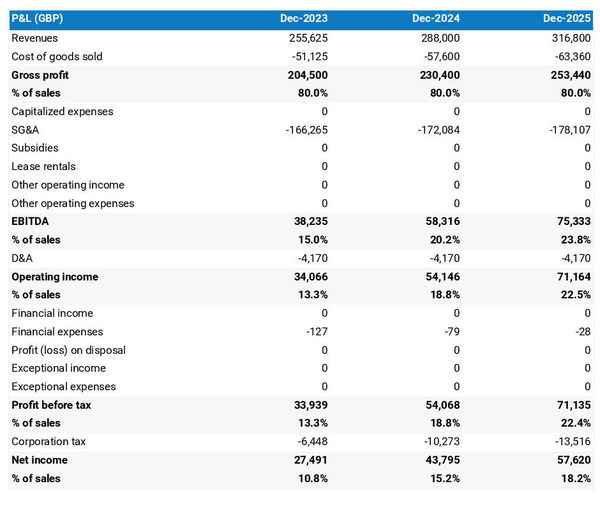
For your risk assessment company to be financially viable, your projected P&L should ideally show:
- Sales growing above inflation (the higher the better)
- Profit margins which are stable or expanding (the higher the better)
- A net profit at the end of each financial year (the higher the better)
This is for established risk assessment companies, there is some leniency for startups which will have numbers that will look a bit different than existing businesses.
The projected balance sheet
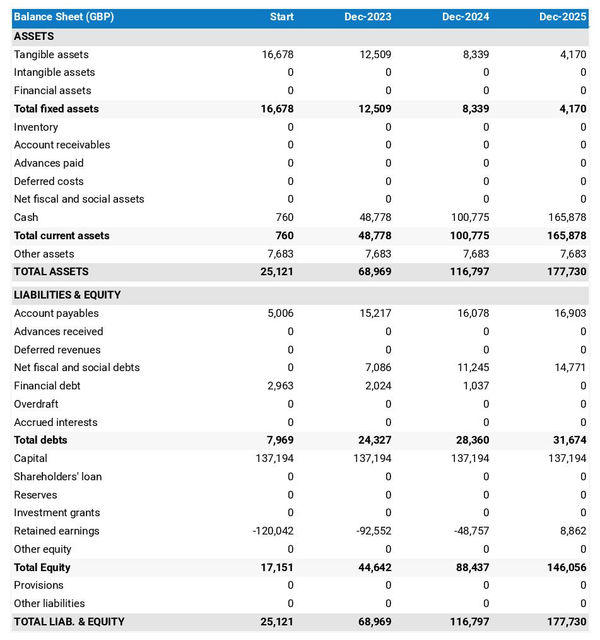
Your risk assessment company's projected balance sheet provides a snapshot of your business’s financial position at year-end.
It is composed of three types of elements: assets, liabilities and equity:
- Assets: represent what the business possesses including cash, equipment, and accounts receivable (money owed by clients).
- Liabilities: represent funds advanced to the business by lenders and other creditors. They include accounts payable (money owed to suppliers), taxes payable and loans from banks and financial institutions.
- Equity: is the combination of what has been invested by the business owners and the cumulative profits and losses generated by the business to date (which are called retained earnings). Equity is a proxy for the value of the owner's stake in the business.
The cash flow projection
The cash flow forecast of your risk assessment company will show how much cash the business is expected to generate or consume over the next three to five years.
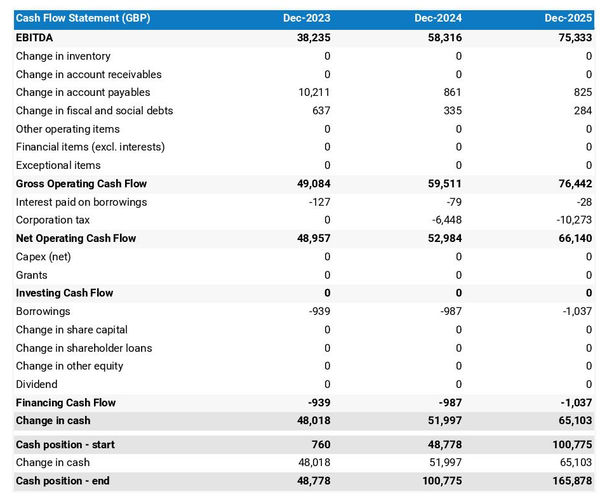
There are multiple ways of presenting a cash flow forecast but from experience, it is better to organise it by nature in order to clearly show these elements:
- Operating cash flow: how much cash is generated by the risk assessment company's operations
- Investing cash flow: what is the business investing to expand or maintain its equipment
- Financing cash flow: is the business raising additional funds or repaying financiers (debt repayment, dividends)
Your cash flow forecast is the most important element of your overall financial projection and that’s where you should focus your attention to ensure that your risk assessment company is adequately funded.
Note: if you are preparing a financial forecast in order to try to secure funding, you will need to include both a yearly and monthly cash flow forecast in your risk assessment company's financial plan.
Need a convincing business plan?
The Business Plan Shop makes it easy to create a financial forecast to assess the potential profitability of your projects, and write a business plan that’ll wow investors.
Which tool should you use to create your risk assessment company's financial forecast?
Using the right tool or solution will make the creation of your risk assessment company's financial forecast much easier than it sounds. Let’s explore the main options.
Using online financial forecasting software to build your risk assessment company's projections
The modern and easiest way is to use professional online financial forecasting software such as the one we offer at The Business Plan Shop.
There are several advantages to using specialised software:
- You can easily create your financial forecast by letting the software take care of the financial calculations for you without errors
- You have access to complete financial forecast templates
- You get a complete financial forecast ready to be sent to your bank or investors
- You can easily track your actual financial performance against your financial forecast, and recalibrate your forecast as the year goes by
- You can create scenarios to stress test your forecast's main assumptions
- You can easily update your forecast as time goes by to maintain visibility on future cash flows
- You have a friendly support team on standby to assist you when you are stuck
- It’s cost-efficient and much cheaper than using an accountant or consultant (see below)
If you are interested in this type of solution, you can try our forecasting software for free by signing up here.
Calling in a financial consultant or chartered accountant
Enlisting the help of a consultant or accountant is also a good way to obtain a professional risk assessment company financial forecast.
The downside of this solution is its cost. From experience, obtaining a simple financial forecast over three years (including a balance sheet, income statement, and cash flow statement) is likely to cost a minimum of £700 or $1,000.
The indicative cost above, is for a small business, and a forecast is done as a one-shot exercise. Using a consultant or accountant to track your actuals vs. forecast and to keep your financial projections up to date on a monthly or quarterly basis will cost a lot more.
If you opt for this solution, make sure your accountant has in-depth knowledge of your industry, so that they may challenge your figures and offer insights (as opposed to just taking your assumptions at face value to create the forecast).
Why not use a spreadsheet such as Excel or Google Sheets to build your risk assessment company's financial forecast?
Creating an accurate and error-free risk assessment company financial forecast on Excel (or any spreadsheet) is very technical and requires both a strong grasp of accounting principles and solid skills in financial modelling.
Most entrepreneurs lack the expertise required to create an accurate financial forecast using spreadsheet software like Excel or Google Sheets. As a result, it is unlikely anyone will trust your numbers.
The second reason is that it is inefficient. Building forecasts on spreadsheets was the only option in the 1990s and early 2000s, nowadays technology has advanced and software can do it much faster and much more accurately.
This is why professional forecasters all use software. With the rise of AI, software is also becoming smarter at helping us detect mistakes in our forecasts and helping us analyse the numbers to make better decisions.
Finally, like everything with spreadsheets, tracking actuals vs. forecasts and updating your forecast as the year progresses is manual, tedious, error-prone, and time-consuming. Whereas financial forecasting software like The Business Plan Shop is built for this.
Need a convincing business plan?
The Business Plan Shop makes it easy to create a financial forecast to assess the potential profitability of your projects, and write a business plan that’ll wow investors.
Use our financial forecast templates for inspiration
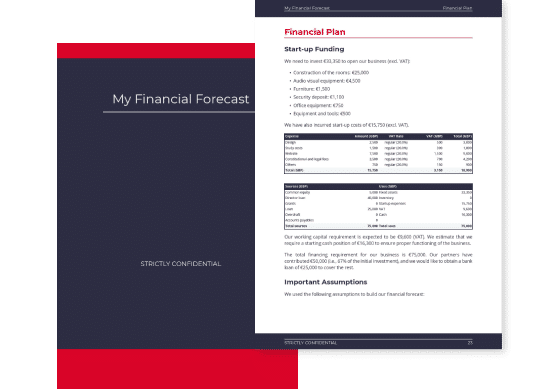
The Business Plan Shop has dozens of financial forecast examples available.
Our templates contain both a financial forecast and a written business plan which presents, in detail, the company, the team, the strategy, and the medium-term objectives.
Our templates are a great source of inspiration, whether you just want to see what a complete business plan looks like, or are looking for concrete examples of how you should model financial elements in your own forecast.
Takeaways
- A financial forecast shows expected growth, profitability, and cash generation metrics for your risk assessment company.
- Tracking actuals vs. forecast and having an up-to-date financial forecast is key to maintaining visibility on your future cash flows.
- Using financial forecasting software is the modern way of creating and maintaining financial projections.
We hope that this guide helped you gain a clearer perspective on the steps needed to create the financial forecast for a risk assessment company. Don't hesitate to contact us if you have any questions!
Need a convincing business plan?
The Business Plan Shop makes it easy to create a financial forecast to assess the potential profitability of your projects, and write a business plan that’ll wow investors.
Also on The Business Plan Shop
- Financial forecast example
- How to create a turnover forecast for a business?
- Example of financial forecast for business idea
Know someone who runs a risk assessment company? Share our business guide with them!

Founder & CEO at The Business Plan Shop Ltd