How to create a financial forecast for a mussel farm?
Developing and maintaining an up-to-date financial forecast for your mussel farm is key in order to maintain visibility on your business’s future cash flows.
If you feel overwhelmed at the thought of putting together a mussel farm financial forecast then don’t worry as this guide is here to help you.
We'll cover everything from: the main objectives of a financial forecast, the data you need to gather before starting, to the tables that compose it, and the tools that will help you create and maintain your forecast efficiently.
Let's get started!
Why create and maintain a financial forecast for a mussel farm?
Creating and maintaining an up-to-date financial forecast is the only way to steer the development of your mussel farm and ensure that it can be financially viable in the years to come.
A financial plan for a mussel farm enables you to look at your business in detail - from income to operating costs and investments - to evaluate its expected profitability and future cash flows.
This gives you the visibility needed to plan future investments and expansion with confidence.
And, when your trading environment gets tougher, having an up to date mussel farm forecast enables you to detect potential upcoming financing shortfalls in advance, enabling you to make adjustments or secure financing before you run out of cash.
It’s also important to remember that your mussel farm's financial forecast will be essential when looking for financing. You can be 100% certain that banks and investors will ask to see your numbers, so make sure they’re set out accurately and attractively.
Need a convincing business plan?
The Business Plan Shop makes it easy to create a financial forecast to assess the potential profitability of your projects, and write a business plan that’ll wow investors.
What information is used as input to build a mussel farm financial forecast?
A mussel farm's financial forecast needs to be built on the right foundation: your assumptions.
The data required to create your assumptions will depend on whether you are a new or existing mussel farm.
If you are creating (or updating) the forecast of an existing mussel farm, then your main inputs will be historical accounting data and operating metrics, and your team’s view on what to expect for the next three to five years.
If you are building financial projections for a new mussel farm startup, you will need to rely on market research to form your go-to-market strategy and derive your sales forecast.
For a new venture, you will also need an itemised list of resources needed for the mussel farm to operate, along with a list of equipment required to launch the venture (more on that below).
Now that you understand what is needed, let’s have a look at what elements will make up your mussel farm's financial forecast.
The sales forecast for a mussel farm
The sales forecast, also called topline projection, is normally where you will start when building your mussel farm financial forecast.
Creating a coherent sales projection boils down to estimating two key drivers:
- The average price
- The number of monthly transactions
To do this, you will need to rely on historical data (for an existing business), market research data (for both new and existing mussel farms), and consider the elements below:
- Seasonal Demand: As a mussel farm owner, you may experience fluctuations in the average price and number of monthly transactions due to seasonal demand. During peak seasons, such as summer, demand for mussels may be higher, resulting in higher prices and more transactions. However, during off-peak seasons, the demand may decrease, leading to lower prices and fewer transactions.
- Weather Conditions: The weather can also greatly impact the average price and number of monthly transactions for your mussel farm. Severe weather events, such as storms or hurricanes, can disrupt operations and decrease the supply of mussels, leading to higher prices. On the other hand, favorable weather conditions can increase the supply and lower prices.
- Competitor Prices: Your average price and number of monthly transactions may also be affected by the prices set by your competitors. If your competitors are offering lower prices for their mussels, you may need to adjust your prices to remain competitive. This can result in a decrease in your average price and an increase in transactions.
- Consumer Preferences: Changes in consumer preferences can also impact your mussel farm's sales forecast. With increasing health consciousness, there may be a higher demand for organic or sustainably farmed mussels, leading to higher prices. Conversely, if consumers shift towards alternative seafood options, this may result in a decrease in demand and lower prices for your mussels.
- Government Regulations: Government regulations can also play a role in the average price and number of monthly transactions for your mussel farm. Changes in regulations, such as stricter environmental standards, can increase production costs, leading to higher prices for your mussels. Additionally, regulations related to import/export can impact the supply and demand for mussels in your market.
After the sales forecast comes the operating expenses budget, which we will now look into in more detail.
Need a convincing business plan?
The Business Plan Shop makes it easy to create a financial forecast to assess the potential profitability of your projects, and write a business plan that’ll wow investors.
The operating expenses for a mussel farm
The next step is to estimate the costs you’ll have to incur to operate your mussel farm.
These will vary based on where your business is located, and its overall size (level of sales, personnel, etc.).
But your mussel farm's operating expenses should normally include the following items:
- Mussel Seed: The cost of purchasing mussel seed from a supplier to start your farm.
- Labor Costs: The wages and benefits for the workers on your mussel farm, including harvesters, processors, and administrative staff.
- Equipment Maintenance: The cost of maintaining and repairing equipment used on the farm, such as boats, nets, and processing machinery.
- Fuel Costs: The cost of fuel used for running boats and other equipment on the farm.
- Feed: The cost of purchasing and providing food for the mussels, such as algae or other nutrients.
- Packaging Materials: The cost of packaging materials, such as bags or containers, for harvesting and shipping the mussels.
- Transportation: The cost of transporting mussels from the farm to buyers or markets.
- Accounting Fees: The fees for hiring an accountant to help with financial record-keeping and tax preparation.
- Insurance: The cost of insuring your farm against potential risks, such as storm damage or theft.
- Software Licenses: Any fees for using software programs to help with farm management and record-keeping.
- Banking Fees: The fees associated with maintaining a bank account and making transactions for your farm.
- Permits and Licensing: The cost of obtaining permits and licenses required for operating a mussel farm.
- Marketing and Advertising: The cost of promoting your farm and mussels to potential buyers and customers.
- Utilities: The cost of electricity, water, and other utilities used on the farm.
- Rent or Land Lease: If you do not own the land on which your mussel farm operates, the cost of renting or leasing the land.
This list is not exhaustive by any means, and will need to be tailored to your mussel farm's specific circumstances.
What investments are needed to start or grow a mussel farm?
Your mussel farm financial forecast will also need to include the capital expenditures (aka investments in plain English) and initial working capital items required for the creation or development of your business.
For a mussel farm, these could include:
- Mussel seed: As a mussel farmer, one of your main expenses will be purchasing mussel seed to start your farm. This can include both wild-caught seed and hatchery-produced seed.
- Farming equipment: To grow and harvest mussels, you will need a variety of equipment such as buoys, lines, nets, and harvesting tools. These are essential fixed assets for your farm.
- Boats and barges: Depending on the size and location of your farm, you may need to invest in boats and barges for transportation and maintenance purposes. These are important fixed assets that will require significant capital investment.
- Processing and storage facilities: As a mussel farmer, you will need to process and store your mussels before selling them. This may require the construction or purchase of facilities such as depuration tanks, grading machines, and refrigeration units.
- Infrastructure and site development: Before you can start farming mussels, you will need to develop your site to create suitable growing conditions. This may include building docks, installing moorings, and constructing access roads.
Again, this list will need to be adjusted according to the size and ambitions of your mussel farm.
Need a convincing business plan?
The Business Plan Shop makes it easy to create a financial forecast to assess the potential profitability of your projects, and write a business plan that’ll wow investors.
The financing plan of your mussel farm
The next step in the creation of your financial forecast for your mussel farm is to think about how you might finance your business.
You will have to assess how much capital will come from shareholders (equity) and how much can be secured through banks.
Bank loans will have to be modelled so that you can separate the interest expenses from the repayments of principal, and include all this data in your forecast.
Issuing share capital and obtaining a bank loan are two of the most common ways that entrepreneurs finance their businesses.
What tables compose the financial plan for a mussel farm?
Now let's have a look at the main output tables of your mussel farm's financial forecast.
The forecasted profit & loss statement
The profit & loss forecast gives you a clear picture of your business’ expected growth over the first three to five years, and whether it’s likely to be profitable or not.
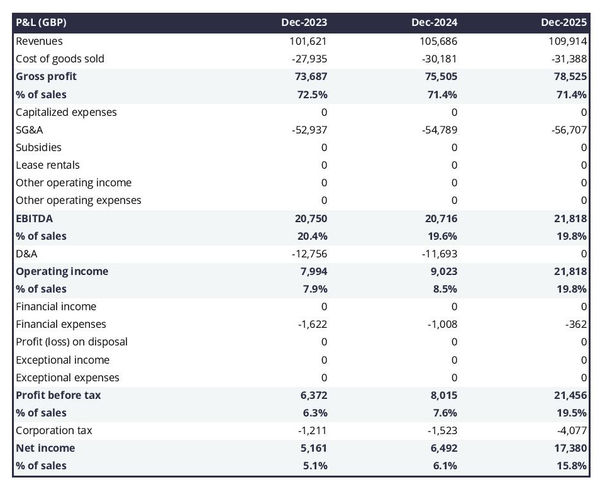
A healthy mussel farm's P&L statement should show:
- Sales growing at (minimum) or above (better) inflation
- Stable (minimum) or expanding (better) profit margins
- A healthy level of net profitability
This will of course depend on the stage of your business: numbers for an established mussel farm will look different than for a startup.
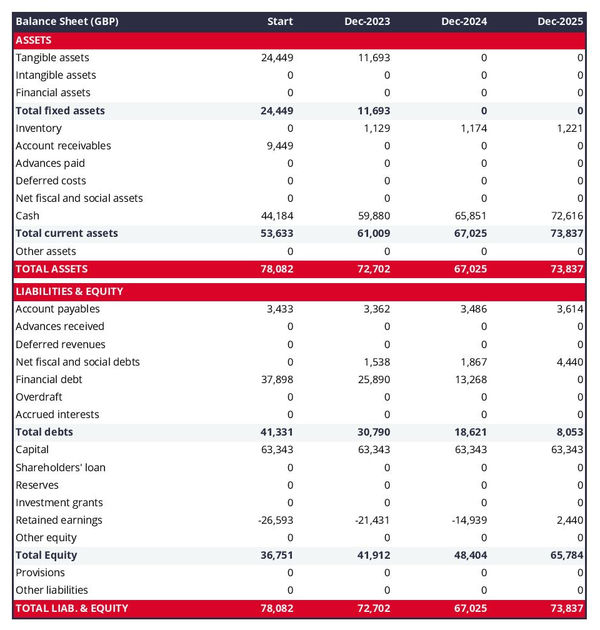
The projected balance sheet
The projected balance sheet gives an overview of your mussel farm's financial structure at the end of the financial year.
It is composed of three categories of items: assets, liabilities and equity:
- Assets: are what the business possesses and uses to produce cash flows. It includes resources such as cash, buildings, equipment, and accounts receivable (money owed by clients).
- Liabilities: are the debts of your mussel farm. They include accounts payable (money owed to suppliers), taxes due and bank loans.
- Equity: is the combination of what has been invested by the business owners and the cumulative profits to date (which are called retained earnings). Equity is a proxy for the value of the owner's stake in the business.
The cash flow forecast
Your mussel farm's cash flow forecast shows how much cash your business is expected to consume or generate in the years to come.
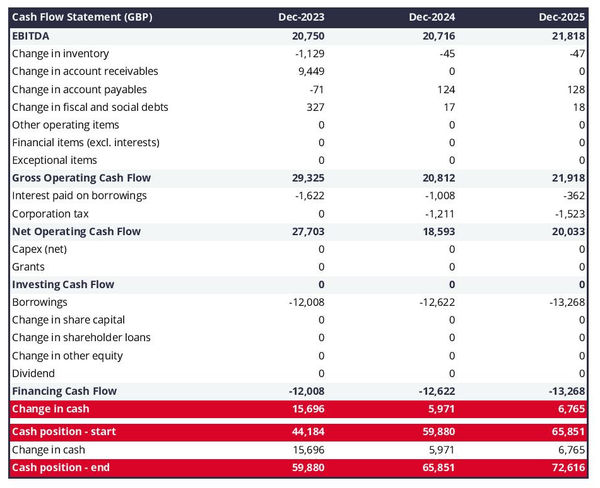
It is best practice to organise the cash flow forecast by nature to better explain where cash is used or generated by the mussel farm:
- Operating cash flow: shows how much cash is generated by the operating activities
- Investing cash flow: shows how much will be invested in capital expenditure to maintain or expand the business
- Financing cash flow: shows if the business is raising new capital or repaying financiers (debt repayment, dividends)
Keeping an eye on (and regularly updating) your mussel farm's cash flow forecast is key to ensuring that your business has sufficient liquidity to operate normally and to detect financing requirements as early as possible.
If you are trying to raise capital, you will normally be asked to provide a monthly cash flow forecast in your mussel farm's financial plan - so that banks or investors can assess seasonal variation and ensure your business is appropriately capitalised.
Need a convincing business plan?
The Business Plan Shop makes it easy to create a financial forecast to assess the potential profitability of your projects, and write a business plan that’ll wow investors.
Which tool should you use to create your mussel farm's financial projections?
Building a mussel farm financial forecast is not difficult provided that you use the right tool for the job. Let’s see what options are available below.
Using online financial forecasting software to build your mussel farm's projections
The modern and easiest way is to use an online financial forecasting tool such as the one we offer at The Business Plan Shop.
There are several advantages to using specialised software:
- You can easily create your financial forecast by letting the software take care of the financial calculations for you without errors
- You have access to complete financial forecast templates
- You get a complete financial forecast ready to be sent to your bank or investors
- You can easily track your actual financial performance against your financial forecast, and recalibrate your forecast as the year goes by
- You can create scenarios to stress test your forecast's main assumptions
- You can easily update your forecast as time goes by to maintain visibility on future cash flows
- You have a friendly support team on standby to assist you when you are stuck
- It’s cost-efficient and much cheaper than using an accountant or consultant (see below)
If you are interested in this type of solution, you can try our projection software for free by signing up here.
Calling in a financial consultant or chartered accountant
Outsourcing the creation of your mussel farm financial forecast is another possible solution.
This will cost more than using software as you can expect as your price will have to cover the accountant’s time, software cost, and profit margin.
Price can vary greatly based on the complexity of your business. For a small business, from experience, a simple three-year financial forecast (including a balance sheet, income statement, and cash flow statement) will start at around £700 or $1,000.
Bear in mind that this is for forecasts produced at a single point in time, updating or tracking your forecast against actuals will cost extra.
If you decide to outsource your forecasting:
- Make sure the professional has direct experience in your industry and is able to challenge your assumptions constructively.
- Steer away from consultants using sectorial ratios to build their client’s financial forecasts (these projections are worthless for a small business).
Why not use a spreadsheet such as Excel or Google Sheets to build your mussel farm's financial forecast?
Creating an accurate and error-free mussel farm financial forecast on Excel (or any spreadsheet) is very technical and requires both a strong grasp of accounting principles and solid skills in financial modelling.
Most entrepreneurs lack the expertise required to create an accurate financial forecast using spreadsheet software like Excel or Google Sheets. As a result, it is unlikely anyone will trust your numbers.
The second reason is that it is inefficient. Building forecasts on spreadsheets was the only option in the 1990s and early 2000s, nowadays technology has advanced and software can do it much faster and much more accurately.
This is why professional forecasters all use software. With the rise of AI, software is also becoming smarter at helping us detect mistakes in our forecasts and helping us analyse the numbers to make better decisions.
Finally, like everything with spreadsheets, tracking actuals vs. forecasts and updating your forecast as the year progresses is manual, tedious, error-prone, and time-consuming. Whereas financial forecasting software like The Business Plan Shop is built for this.
Need a convincing business plan?
The Business Plan Shop makes it easy to create a financial forecast to assess the potential profitability of your projects, and write a business plan that’ll wow investors.
Use our financial projection templates for inspiration
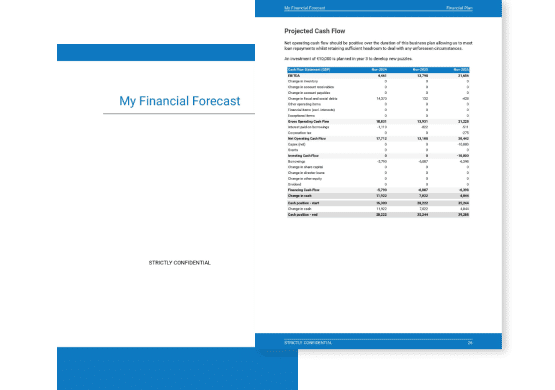
The Business Plan Shop has dozens of financial forecasting templates available.
Our examples contain both the financial forecast, and a written business plan which presents, in detail, the company, the team, the strategy, and the medium-term objectives.
Whether you are just starting out or already have your own mussel farm, looking at our template is always a good way to get ideas on how to model financial items and what to write when creating a business plan to secure funding.
Takeaways
- Having a financial forecast enables you to visualise the expected growth, profitability, and cash generation for your business over the next three to five years.
- Tracking actuals vs. forecast and keeping your financial projections up-to-date is the only way to get a view on what your mussel farm future cash flows may look like.
- Using financial forecasting software is the mordern and easy way to create and maintain your forecasts.
This is the end of our guide on how to build the financial forecast for a mussel farm, we hope you found it useful. Don't hesitate to contact us if you want to share your feedback or have any questions.
Need a convincing business plan?
The Business Plan Shop makes it easy to create a financial forecast to assess the potential profitability of your projects, and write a business plan that’ll wow investors.
Also on The Business Plan Shop
- Example of financial forecast
- How to project sales for a business?
- Example of financial forecast for business idea
Know someone who owns or is thinking of starting a mussel farm? Share our forecasting guide with them!

Founder & CEO at The Business Plan Shop Ltd