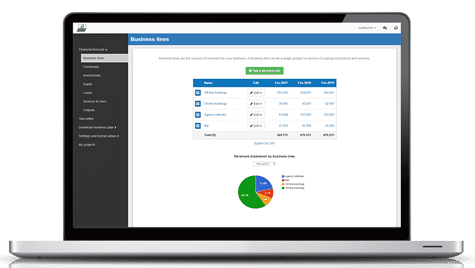
How to create a financial forecast for a stylist company?

Developing and maintaining an up-to-date financial forecast for your stylist company is key in order to maintain visibility on your business’s future cash flows.
If you feel overwhelmed at the thought of putting together a stylist company financial forecast then don’t worry as this guide is here to help you.
We'll cover everything from: the main objectives of a financial forecast, the data you need to gather before starting, to the tables that compose it, and the tools that will help you create and maintain your forecast efficiently.
Let's get started!
Why create and maintain a financial forecast for a stylist company?
In order to prosper, your business needs to have visibility on what lies ahead and the right financial resources to grow. This is where having a financial forecast for your stylist company becomes handy.
Creating a stylist company financial forecast forces you to take stock of where your business stands and where you want it to go.
Once you have clarity on the destination, you will need to draw up a plan to get there and assess what it means in terms of future profitability and cash flows for your stylist company.
Having this clear plan in place will give you the confidence needed to move forward with your business’s development.
Having an up-to-date financial forecast for a stylist company is also useful if your trading environment worsens, as the forecast enables you to adjust to your new market conditions and anticipate any potential cash shortfall.
Finally, your stylist company's financial projections will also help you secure financing, as banks and investors alike will want to see accurate projections before agreeing to finance your business.
Need a convincing business plan?
The Business Plan Shop makes it easy to create a financial forecast to assess the potential profitability of your projects, and write a business plan that’ll wow investors.
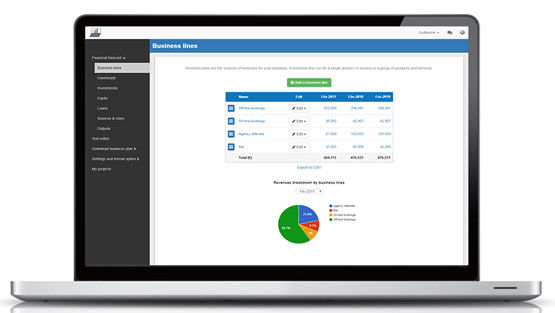
What information is used as input to build a stylist company financial forecast?
A stylist company's financial forecast needs to be built on the right foundation: your assumptions.
The data required to create your assumptions will depend on whether you are a new or existing stylist company.
If you are creating (or updating) the forecast of an existing stylist company, then your main inputs will be historical accounting data and operating metrics, and your team’s view on what to expect for the next three to five years.
If you are building financial projections for a new stylist company startup, you will need to rely on market research to form your go-to-market strategy and derive your sales forecast.
For a new venture, you will also need an itemised list of resources needed for the stylist company to operate, along with a list of equipment required to launch the venture (more on that below).
Now that you understand what is needed, let’s have a look at what elements will make up your stylist company's financial forecast.
The sales forecast for a stylist company
From experience, it usually makes sense to start your stylist company's financial projection with the revenues forecast.
The inputs used to forecast your sales will include the historical trading data of your stylist company (which can be used as a starting point for existing businesses) and the data collected in your market research (which both new ventures and existing businesses need to project their sales forward).
Your stylist company's sales forecast can be broken down into two key estimates:
- The average price
- The number of monthly transactions
To assess these variables accurately, you will need to consider the following factors:
- Seasonal Trends: As a stylist company, you may experience fluctuations in average price and number of transactions depending on the time of year. For example, during wedding season, you may see an increase in demand for bridal styling services, leading to higher average prices and more transactions.
- Local Economy: The state of the local economy can also have an impact on your business's average price and number of transactions. During times of economic growth, customers may be more willing to spend money on luxury services, leading to higher average prices. Conversely, during an economic downturn, customers may opt for more affordable services, resulting in lower average prices and fewer transactions.
- Competition: The presence of other stylist companies in your area can also affect your business's average price and number of transactions. If you have a lot of competition, you may need to lower your prices to remain competitive and attract customers. On the other hand, if you have a strong reputation and loyal customer base, you may be able to charge higher prices and maintain a steady number of transactions.
- Customer Preferences: As a stylist company, it's important to stay up-to-date on current fashion and beauty trends. Changes in customer preferences can have a significant impact on your business's average price and number of transactions. For example, if there is a sudden shift towards more natural, low-maintenance hairstyles, you may see a decrease in demand for your more elaborate and expensive services.
- Location: The location of your stylist company can also play a role in your average price and number of transactions. If you are located in a high-end, affluent area, you may be able to charge higher prices for your services. On the other hand, if you are located in a more budget-friendly area, you may need to adjust your prices to appeal to your target market.
Once you have a sales forecast in place, the next step will be to work on your overhead budget. Let’s have a look at that now.
Need a convincing business plan?
The Business Plan Shop makes it easy to create a financial forecast to assess the potential profitability of your projects, and write a business plan that’ll wow investors.
The operating expenses for a stylist company
Once you know what level of sales you can expect, you can start budgeting the expenses required to operate your stylist company on a daily basis.
Expenses normally vary based on how much revenue you anticipate (which is why, from experience, it is always better to start your forecast with the topline projection), and where your business is based.
Operating expenses for a stylist company will include some of the following items:
- Staff Costs: This includes the salaries and wages of all employees, including stylists, assistants, and administrative staff.
- Rent: You will need to pay rent for your salon space, whether you lease or own it.
- Utilities: This includes electricity, water, and gas for your salon.
- Inventory: You will need to purchase and restock hair products, tools, and other supplies regularly.
- Advertising and Marketing: To attract new clients and promote your services, you will need to invest in advertising and marketing efforts.
- Accountancy Fees: You may need to hire an accountant to help with bookkeeping, taxes, and other financial tasks.
- Insurance Costs: You will need to have insurance coverage for your salon, employees, and equipment.
- Software Licenses: You may need to purchase software licenses for scheduling, booking, and other management tasks.
- Banking Fees: There may be fees associated with maintaining a business bank account and processing transactions.
- Professional Memberships: You may choose to join professional organizations or associations for networking and education purposes.
- Training and Education: To keep up with the latest trends and techniques, you may need to invest in training and education for yourself and your employees.
- Equipment Maintenance: Regular maintenance and repairs for your salon equipment are necessary to keep them in good working condition.
- Cleaning and Maintenance: You will need to pay for cleaning services and supplies to keep your salon clean and presentable.
- Taxes and Licenses: As a business owner, you will have to pay taxes and obtain any necessary licenses or permits for your salon.
- Office Supplies: You will need to purchase office supplies such as paper, pens, and printer ink to keep your administrative tasks running smoothly.
This list will need to be tailored to the specificities of your stylist company, but should offer a good starting point for your budget.
What investments are needed to start or grow a stylist company?
Once you have an idea of how much sales you could achieve and what it will cost to run your stylist company, it is time to look into the equipment required to launch or expand the activity.
For a stylist company, capital expenditures and initial working capital items could include:
- Salon Equipment: This includes items such as styling chairs, shampoo bowls, hair dryers, and styling stations. These are essential fixed assets that are necessary for your stylist company to operate and generate revenue.
- Inventory: As a stylist company, you will need to invest in inventory to offer a variety of products and services to your clients. This may include hair care products, styling tools, and other beauty products.
- Furniture: In addition to salon equipment, you may also need to purchase furniture such as waiting area chairs, reception desk, and storage units. These are important fixed assets that will provide a comfortable and professional environment for your clients.
- Renovations/Remodeling: If you are starting a new stylist company, you may need to invest in renovations or remodeling to create a functional and visually appealing salon space. This may include flooring, lighting, and painting.
- Technology: In today's digital age, investing in technology is crucial for the success of a stylist company. This may include computer systems, software, and point-of-sale systems to manage your business operations and client transactions.
Again, this list will need to be adjusted according to the specificities of your stylist company.
Need a convincing business plan?
The Business Plan Shop makes it easy to create a financial forecast to assess the potential profitability of your projects, and write a business plan that’ll wow investors.
The financing plan of your stylist company
The next step in the creation of your financial forecast for your stylist company is to think about how you might finance your business.
You will have to assess how much capital will come from shareholders (equity) and how much can be secured through banks.
Bank loans will have to be modelled so that you can separate the interest expenses from the repayments of principal, and include all this data in your forecast.
Issuing share capital and obtaining a bank loan are two of the most common ways that entrepreneurs finance their businesses.
What tables compose the financial plan for a stylist company?
Now let's have a look at the main output tables of your stylist company's financial forecast.
The projected profit & loss statement
The projected profit & loss shows how profitable your stylist company is likely to be in the years to come.
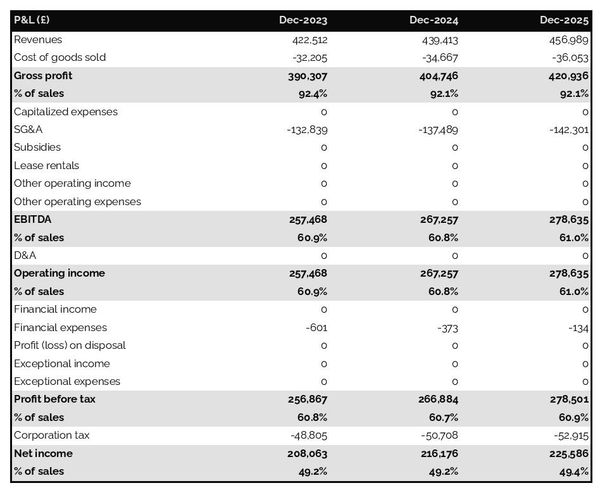
For your stylist company to be financially viable, your projected P&L should ideally show:
- Sales growing above inflation (the higher the better)
- Profit margins which are stable or expanding (the higher the better)
- A net profit at the end of each financial year (the higher the better)
This is for established stylist companies, there is some leniency for startups which will have numbers that will look a bit different than existing businesses.
The projected balance sheet
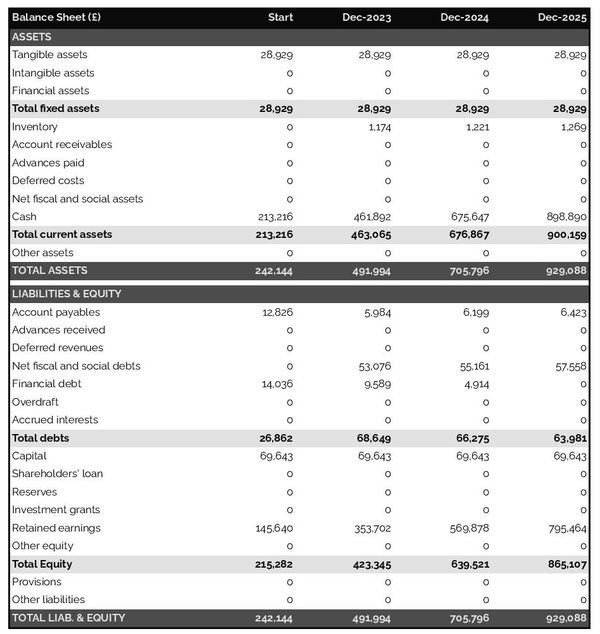
Your stylist company's forecasted balance sheet enables you to assess your financial structure and working capital requirements.
It is composed of three types of elements: assets, liabilities and equity:
- Assets: represent what the business owns and uses to produce cash flows. It includes resources such as cash, equipment, and accounts receivable (money owed by clients).
- Liabilities: represent funds advanced to the business by lenders and other creditors. It includes items such as accounts payable (money owed to suppliers), taxes due and loans.
- Equity: is the combination of what has been invested by the business owners and the cumulative profits and losses generated by the business to date (which are called retained earnings). Equity is a proxy for the value of the owner's stake in the business.
The cash flow forecast
Your stylist company's cash flow forecast shows how much cash your business is expected to consume or generate in the years to come.
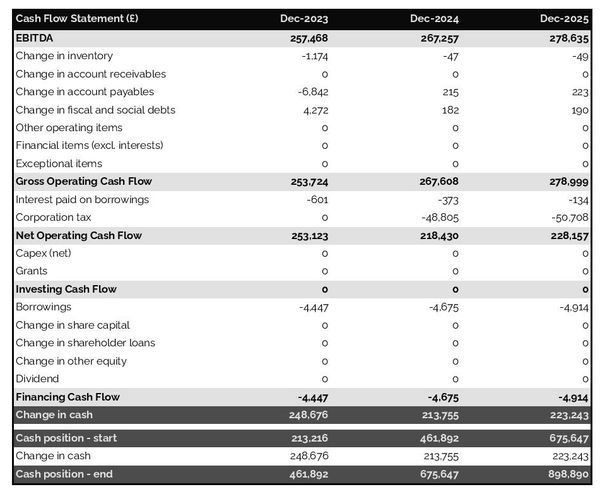
It is best practice to organise the cash flow forecast by nature to better explain where cash is used or generated by the stylist company:
- Operating cash flow: shows how much cash is generated by the operating activities
- Investing cash flow: shows how much will be invested in capital expenditure to maintain or expand the business
- Financing cash flow: shows if the business is raising new capital or repaying financiers (debt repayment, dividends)
Keeping an eye on (and regularly updating) your stylist company's cash flow forecast is key to ensuring that your business has sufficient liquidity to operate normally and to detect financing requirements as early as possible.
If you are trying to raise capital, you will normally be asked to provide a monthly cash flow forecast in your stylist company's financial plan - so that banks or investors can assess seasonal variation and ensure your business is appropriately capitalised.
Need a convincing business plan?
The Business Plan Shop makes it easy to create a financial forecast to assess the potential profitability of your projects, and write a business plan that’ll wow investors.
Which tool should you use to create your stylist company's financial forecast?
Creating your stylist company's financial forecast may sound fairly daunting, but the good news is that there are several ways to go about it.
Using online financial forecasting software to build your stylist company's projections
The modern and easiest way is to use professional online financial forecasting software such as the one we offer at The Business Plan Shop.
There are several advantages to using specialised software:
- You can easily create your financial forecast by letting the software take care of the financial calculations for you without errors
- You have access to complete financial forecast templates
- You get a complete financial forecast ready to be sent to your bank or investors
- You can easily track your actual financial performance against your financial forecast, and recalibrate your forecast as the year goes by
- You can create scenarios to stress test your forecast's main assumptions
- You can easily update your forecast as time goes by to maintain visibility on future cash flows
- You have a friendly support team on standby to assist you when you are stuck
- It’s cost-efficient and much cheaper than using an accountant or consultant (see below)
If you are interested in this type of solution, you can try our forecasting software for free by signing up here.
Hiring a financial consultant or chartered accountant
Hiring a consultant or chartered accountant is also an efficient way to get a professional stylist company financial projection.
As you can imagine, this solution is much more expensive than using software. From experience, the creation of a simple financial forecast over three years (including a balance sheet, income statement, and cash flow statement) is likely to start around £700 or $1,000 excluding taxes.
The indicative estimate above, is for a small business, and a forecast done as a one-off. Using a financial consultant or accountant to track your actuals vs. forecast and to keep your financial forecast up to date on a monthly or quarterly basis will naturally cost a lot more.
If you choose this solution, make sure your service provider has first-hand experience in your industry, so that they may challenge your assumptions and offer insights (as opposed to just taking your figures at face value to create the forecast’s financial statements).
Why not use a spreadsheet such as Excel or Google Sheets to build your stylist company's financial forecast?
Creating an accurate and error-free stylist company financial forecast with a spreadsheet is very technical and requires a deep knowledge of accounting and an understanding of financial modelling.
Very few business owners are financially savvy enough to be able to build a forecast themselves on Excel without making mistakes.
Lenders and investors know this, which is why forecasts created on Excel by the business owner are often frowned upon.
Having numbers one can trust is key when it comes to financial forecasting and to that end using software is much safer.
Using financial forecasting software is also faster than using a spreadsheet, and, with the rise of artificial intelligence, software is also becoming smarter at helping us analyse the numbers to make smarter decisions.
Finally, like everything with spreadsheets, tracking actuals vs. forecasts and keeping your projections up to date as the year progresses is manual, tedious, and error-prone. Whereas financial projection software like The Business Plan Shop is built for this.
Need a convincing business plan?
The Business Plan Shop makes it easy to create a financial forecast to assess the potential profitability of your projects, and write a business plan that’ll wow investors.
Use our financial projection templates for inspiration
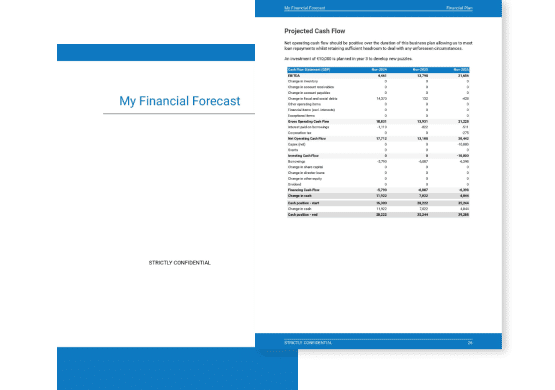
The Business Plan Shop has dozens of financial forecasting templates available.
Our examples contain both the financial forecast, and a written business plan which presents, in detail, the company, the team, the strategy, and the medium-term objectives.
Whether you are just starting out or already have your own stylist company, looking at our template is always a good way to get ideas on how to model financial items and what to write when creating a business plan to secure funding.
Takeaways
- A financial forecast shows expected growth, profitability, and cash generation metrics for your stylist company.
- Tracking actuals vs. forecast and having an up-to-date financial forecast is key to maintaining visibility on your future cash flows.
- Using financial forecasting software is the modern way of creating and maintaining financial projections.
We hope that this guide helped you gain a clearer perspective on the steps needed to create the financial forecast for a stylist company. Don't hesitate to contact us if you have any questions!
Need a convincing business plan?
The Business Plan Shop makes it easy to create a financial forecast to assess the potential profitability of your projects, and write a business plan that’ll wow investors.
Also on The Business Plan Shop
- Financial forecast example
- Sample financial forecast for business idea
- How to project sales for a business?
Know someone who runs a stylist company? Share our business guide with them!

Founder & CEO at The Business Plan Shop Ltd