How to open an agronomy consulting company?

Are you keen to open an agronomy consulting company but don't know where to begin? Then you're in luck because this guide will lead you through all the steps required to check if your business idea can be profitable and, if so, turn it into a reality.
Our guide is for prospective entrepreneurs who are thinking about starting an agronomy consulting company no matter how far they are in their journey - whether you’re just thinking about it or in the middle of market research this guide will be useful to you.
Think of this as your blueprint: we cover everything you need to know about opening an agronomy consulting company and what key decisions you’ll need to make along the way.
Ready? Let’s get started!
What is the business model of an agronomy consulting company?
Before thinking about starting an agronomy consulting company, you'll need to have a solid understanding of its business model (how it generates profits) and how the business operates on a daily basis.
Doing so will help you decide whether or not this is the right business idea for you, given your skillset, personal savings, and lifestyle choices.
Looking at the business model in detail will also enable you to form an initial view of the potential for growth and profitability, and to check that it matches your level of ambition.
The easiest ways to acquire insights into how an agronomy consulting company works are to:
- Speak with agronomy consulting company owners
- Undertake work experience with a successful agronomy consulting company
- Participate in a training course
Speak with agronomy consulting company owners
Talking to seasoned entrepreneurs who have also set up an agronomy consulting company will enable you to gain practical advice based on their experience and hindsight.
Learning from others' mistakes not only saves you time and money, but also enhances the likelihood of your venture becoming a financial success.
Undertake work experience with a successful agronomy consulting company
Gaining hands-on experience in an agronomy consulting company provides insights into the day-to-day operations, and challenges specific to the activity.
This firsthand knowledge is crucial for effective planning and management if you decide to start your own agronomy consulting company.
You'll also realise if the working hours suit your lifestyle. For many entrepreneurs, this can be a "make or break" situation, especially if they have children to look after.
First-hand experience will not only ensure that this is the right business opportunity for you, but will also enable you to meet valuable contacts and gain a better understanding of customer expectations and key success factors which will likely prove advantageous when launching your own agronomy consulting company.
Participate in a training course
Undertaking training within your chosen industry is another way to get a feel for how an agronomy consulting company works before deciding to pursue a new venture.
Whichever approach you go for to gain insights before starting your agronomy consulting company, make sure you familiarise yourself with:
- The expertise needed to run the business successfully (do you have the skills required?)
- How a week of running an agronomy consulting company might look like (does this fit with your personal situation?)
- The potential turnover of your agronomy consulting company and long-term growth prospects (does this match your ambition?)
- The likely course of action if you decide to sell the company or retire (it's never too early to consider your exit)
At the end of this stage, you should be able to decide whether opening an agronomy consulting company is the right business idea for you given your current personal situation (skills, desires, money, family, etc.).
Can your business idea be profitable?
Just enter your data and let The Business Plan Shop crunch the numbers. We will tell if your business idea can generate profits and cash flows, and how much you need to get started.
Assembling your agronomy consulting company's founding team
The next step to opening your agronomy consulting company is to think about the ideal founding team, or to decide to go in alone.
Starting and growing a successful business doesn't have to be a solo journey and setting up an agronomy consulting company with several co-founders is generally easier. The business benefits from a management team with a wider skillset, decisions are made together, and the financial risk is shared among the partners, making the journey more collaborative and less daunting.
But, running a business with several partners brings its own challenges. Disagreements between co-founders are quite common, and these can pose risks to the business. That's why it's crucial to consider all aspects before starting your own business.
We won't go into too much detail here, as this is a complex topic that deserves its own guide, but we do recommend that you ask yourself the following questions:
- What is the ideal number of co-founders for this venture?
- Are you on the same wavelength as your potential partners in terms of vision and ambition?
- How will you deal with potential failure?
Let's look at each of these questions in more detail.
What is the ideal number of co-founders for this venture?
To answer this question you will need to consider the following:
- What skills do you need to run the business? Are you lacking any?
- How much startup capital do you need? How much do you have?
- How are key decisions going to be made? - It is usually advisable to have an odd number of partners (or a majority shareholder) to help break the tie.
Put simply, your co-founders contribute skills, capital, or both. Increasing the number of partners becomes advantageous when there is a deficiency in either of these resources.
Are you on the same wavelength as your potential partners in terms of vision and ambition?
Your business partners should share the same short and long-term vision, be it business expansion or social responsibility, to avoid future frustrations and simplify decision-making. Different views are natural, but alignment is ideal.
In any case, you should think of having an exit mechanism in place in case one of the partners wants to move on.
How will you deal with potential failure?
We wish you nothing but success when starting up and growing your agronomy consulting company, but it's always wise to have a backup in case things don't go as planned.
How you deal with a potential failure can vary significantly based on the relationship you have with your business partner (close friend, spouse, ex-colleague, etc.) and the personal circumstances of each of you.
For instance, starting a business with your spouse might seem appealing, but if it doesn't succeed, you risk losing 100% of the household income at once, which could be stressful.
Similarly, going into a partnership with a friend can put pressure on the friendship in the event of failure or when you need to make difficult decisions.
There is no wrong answer, but it is essential to carefully evaluate your options before starting up to ensure you're well-prepared for any potential outcomes.
Is there room for another agronomy consulting company on the market?
The next step in starting an agronomy consulting company is to undertake market research. Now, let's delve into what this entails.
The objectives of market research
The goal here is straightforward: evaluate the demand for your business and determine if there's an opportunity to be seized.
One of the key points of your market analysis will be to ensure that the market is not saturated by competing offers.
The market research to open your agronomy consulting company will also help you to define a concept and market positioning likely to appeal to your target clientele.
Finally, your analysis will provide you with the data you need to assess the revenue potential of your future business.
Let's take a look at how to carry out your market research.
Evaluating key trends in the sector
Market research for an agronomy consulting company usually begins with an analysis of the sector in order to develop a solid understanding of its key players, and recent trends.
Assessing the demand
After the sector analysis comes demand analysis. Demand for an agronomy consulting company refers to customers likely to consume the products and services offered by your company or its competitors.
Looking at the demand will enable you to gain insights into the desires and needs expressed by your future customers and their observed purchasing habits.
To be relevant, your demand analysis must be targeted to the geographic area(s) served by your company.
Your demand analysis should highlight the following points:
- Who buys the type of products and services you sell?
- How many potential customers are there in the geographical area(s) targeted by your company?
- What are their needs and expectations?
- What are their purchasing habits?
- How much do they spend on average?
- What are the main customer segments and their characteristics?
- How to communicate and promote the company's offer to reach each segment?
Analyzing demand helps pinpoint customer segments your agronomy consulting company could target and determines the products or services that will meet their expectations.
Assessing the supply
Once you have a clear vision of who your potential customers are and what they want, the next step is to look at your competitors.
Amongst other things, you’ll need to ask yourself:
- What brands are competing directly/indirectly against your agronomy consulting company?
- How many competitors are there in the market?
- Where are they located in relation to your company's location?
- What will be the balance of power between you and your competitors?
- What types of services and products do they offer? At what price?
- Are they targeting the same customers as you?
- How do they promote themselves?
- Which concepts seem to appeal most to customers?
- Which competitors seem to be doing best?
The aim of your competitive analysis will be to identify who is likely to overshadow you, and to find a way to differentiate yourself (more on this see below).
Regulations
Market research is also an opportunity to look at the regulations and conditions required to do business.
Ask yourself the following questions:
- Do you need a special degree to open an agronomy consulting company?
- Are there necessary licences or permits?
- What are the main laws applicable to your future business?
At this stage, your analysis of the regulations should be carried out at a high level, to familiarize yourself with any rules and procedures, and above all to ensure that you meet the necessary conditions for carrying out the activity before going any further.
You will have the opportunity to come back to the regulation afterwards with your lawyer when your project is at a more advanced stage.
Take stock of the lessons learned from your market analysis
Market research should give you a definitive idea of your business idea's chances of commercial success.
Ideally, the conclusion is that there is a market opportunity because one or more customer segments are currently underserved by the competition.
On the other hand, the conclusion may be that the market is already taken. In this case, don't panic: the first piece of good news is that you're not going to spend several years working hard on a project that has no chance of succeeding. The second is that there's no shortage of ideas out there: at The Business Plan Shop, we've identified over 1,300 business start-up ideas, so you're bound to find something that will work.
Need a convincing business plan?
The Business Plan Shop makes it easy to create a financial forecast and write a business plan to help convince investors that your business idea can be profitable.
How should I position my agronomy consulting company on the market?
The next step to start your agronomy consulting company is to define precisely the market positioning your company will adopt in order to capitalise on the opportunity identified during your market research.
Market positioning refers to the place your product and service offering occupies in customers' minds and how they differ from the competition. Being perceived as a low-cost solution, for example.
To find a concept and a market positioning that will resonate with your customers, you need to address the following issues:
- How can you differentiate yourself from your competitors?
- Is it better to start or buy an agronomy consulting company already in operation?
- How will you validate your concept and market positioning before investing in the business?
Let's look at these aspects in more detail.
How can you differentiate yourself from your competitors?
Opening an agronomy consulting company means starting with a major disadvantage compared with competitors already active on the market.
While you will have to create everything from scratch, your competitors already have everything in place.
Your competitors' teams know the business well, whereas yours has only just been recruited, their customers are loyal and they benefit from word of mouth that you don't yet have.
So you're going to need a solid plan to succeed in taking market share from your competitors and making your mark.
There are a number of aspects to consider in order to try to avoid direct confrontation if possible:
- Can you target a different customer base than your competitors?
- Can you offer products or services that are different from or complementary to what your competitors already sell?
- How will your competitors react to your agronomy consulting company entering their market?
- Can you build a sustainable competitive advantage that will enable you to compete with your current and future competitors?
Is it better to start or buy an agronomy consulting company already in operation?
The alternative to setting up a new independent business is to buy out and take over an agronomy consulting company already in operation.
A takeover is a good way of reducing the risk of your project compared with a pure start-up.
Taking over a business has two enormous advantages over setting up a new one: you start out on an equal footing with your competitors since you take over the team and the customer base, and you don't increase the supply on the market enabling you to maintain the existing balance on the market where the business operates.
However, the capital requirements for a takeover are higher because the business will have to be bought from its previous owners.
How will you validate your concept and market positioning before investing in the business?
However you decide to set up your business, you will need to ensure that there is a good fit between what you sell and what customers are looking to buy.
To do this, you'll need to meet your target customers to present your products or services and check that they meet their expectations.
Explore the ideal location to start your agronomy consulting company
The next stage in our guide on how to start an agronomy consulting company: choosing where to set up shop.
Setting up your business in the right location will have a direct impact on your chances of success, so it's a good idea to think things through before you launch.
To help you decide where to set up your business, we recommend considering the following factors:
- Proximity to target customers - As an agronomy consulting company, it is important to be in close proximity to potential clients such as farmers and agricultural businesses.
- Parking space, road, and public transport accessibility - This will make it easier for clients to visit the location and for consultants to travel to client sites.
- Availability of skilled labor - Having access to a pool of skilled workers in the agricultural industry can be beneficial for the company's operations and growth.
- Competitor presence - It is important to research and consider the presence of other agronomy consulting companies in the area to ensure a competitive advantage.
These criteria will need to be refined according to the specific features of your project.
After weighing the factors mentioned earlier, it's crucial to focus on your startup's budget. Look for a location that suits your business needs while being affordable, especially in the short term.
One of the issues that will also come up is the long-term future of your location, particularly if you opt to rent your premises rather than buy. In this case, you will need to consider the conditions for renewing the lease (duration, rent increases, etc.).
Lease agreements vary widely from country to country, so make sure you check the terms applicable to your situation and have your lawyer review your lease before you sign.
Need inspiration for your business plan?
Avoid writer's block and draft your own business plan in no time by drawing inspiration from dozens of business plan templates.

What legal form should I choose for my agronomy consulting company?
The next step to start an agronomy consulting company is to choose the legal form of your business.
The legal form of a business simply means the legal structure it operates under. This structure outlines how the business is set up and defines its legal obligations and responsibilities.
Why is your agronomy consulting company's legal form important?
Choosing the right legal form for your agronomy consulting company is important because this will affect:
- Taxation: your tax obligations depend on the legal structure you choose, and this principle applies to both personal income tax and business taxes.
- Risk exposure: some legal structures have a legal personality (also known as corporate personality) and limited liability, which separates them from the owners running the business. This means that the business would be liable rather than the owners if things were to go wrong (lawsuit, debt owed in case of bankruptcy, etc.).
- Decision-making and governance: how you make key decisions varies based on the legal form of your business. In some cases you might need to have a board of directors and organise general assemblies to enable shareholders to influence major decisions with their voting rights.
- Financing: securing funding from investors requires you to have a company and they will expect limited liability and corporate personality to protect them legally.
- Paperwork and legal formalities: the legal structure you select determines whether certain obligations are necessary, such as producing annual accounts, or getting your books audited.
Popular business legal forms
The specific names of legal structures vary from country to country, but they usually fall within the two main categories below:
- Individual businesses
- Companies
Individual businesses
Individual businesses, like sole traders or sole proprietorships, are made for self-employed entrepreneurs and freelancers rather than businesses which employ staff.
They benefit from straightforward administrative requirements, minimal paperwork to start, simpler tax calculations, and streamlined accounting procedures.
However, the downside is that there's typically no legal distinction between the business and the person responsible for day-to-day operations. This means the owner's personal assets are at risk if the business faces problems or goes bankrupt.
There is also no share capital in such a structure, meaning that individual businesses cannot raise equity from investors which seriously limits funding options.
Companies
Companies are versatile structures suited to projects of all sizes in terms of number of founders, number of employees and amount of capital.
They are a bit more complex to operate than individual businesses with more formalities, stringent accounting requirements, more complex tax implications, etc.
In return, they offer stronger protections to their shareholders. They usually benefit from having their own legal identity and limited liability, meaning co-founders and investors can only ever lose the amount of money they have put into the company.
For instance, if things were to go south (the company files for bankruptcy or there is a legal issue), the company would take the hit, safeguarding the personal assets of the founders and investors.
How should I choose my agronomy consulting company's legal structure?
Deciding on a legal form is easy once you've estimated your sales, decided whether or not you need employees and figured out the number of co-founders joining you.
It's essential to remember that a solid business idea will succeed no matter which legal structure you pick. Tax laws change regularly, so you can't rely on specific tax advantages tied to a particular structure when starting a business.
A proven approach is to look at what legal structures your top competitors are using, and go with the most common option as a working assumption. Once your idea is mature enough, and you're getting closer to officially registering your business, you can get advice from a lawyer and an accountant to confirm your choice.
Can I switch my agronomy consulting company's legal structure if I get it wrong?
Yes, changing your legal structure later is possible, though it may involve selling the old entity to a new entity in some cases, which adds further expenses. If you want to save on such costs, it makes sense to pick the correct legal form for your business the first time around.
Can your business idea be profitable?
Just enter your data and let The Business Plan Shop crunch the numbers. We will tell if your business idea can generate profits and cash flows, and how much you need to get started.
How much money do I need to start an agronomy consulting company?
To answer this key question, we first need to look at the resources you'll need to launch your agronomy consulting company and keep it running on a daily basis. Let's take a look at what that entails.
Since each venture is distinct, providing an average budget for starting an agronomy consulting company is impossible.
We strongly advise careful consideration when reading estimates on the web. It’s best to ask yourself the following questions:
- Is my project similar (location, concept, planned size, etc.)?
- Can I trust where this information is coming from?
- Is the data fresh or stale?
Your thinking behind the investments and human resources required to launch and operate the business will then enable you to cost each item and include them in your financial forecast (which we'll look at later in this guide).
Once complete, the forecast will give you a precise idea of the initial investment required and profitability potential for your business idea.
Startup costs and investments to start an agronomy consulting company
Let's start with the investments. To set up an agronomy consulting company, initial working capital and investments can include the following items:
- Land and Building: As an agronomy consulting company, you will need a physical location to operate from. This may include purchasing or leasing land for field trials and demonstration plots, as well as a building for office space, storage, and equipment maintenance.
- Equipment and Machinery: Agronomy consulting involves working with various types of machinery and equipment for farming operations. This may include purchasing or leasing vehicles, tractors, sprayers, harvesters, and other specialized equipment for soil testing, crop monitoring, and data collection.
- Technology and Software: In today's digital age, technology plays a crucial role in the success of any business. As an agronomy consulting company, you will need to invest in technology and software for data analysis, mapping, and precision agriculture. This may include purchasing or subscribing to software for soil testing, crop monitoring, and yield prediction.
- Greenhouse and Nursery: If you plan to offer services for greenhouse and nursery production, you may need to invest in a greenhouse structure, heating and cooling systems, irrigation systems, and other equipment for plant propagation and maintenance.
- Research and Development: As an agronomy consulting company, you will need to stay updated with the latest research and technology in the field of agriculture. This may include investing in research and development projects, attending conferences and workshops, and collaborating with universities and research institutions.
Of course, you will need to adapt this list to your company's specific needs.
Staffing requirements to operate an agronomy consulting company
You'll also need to think about the staff required to run the business on a day-to-day basis.
The human resources required will vary according to the size of your company.
Once again, this list is only indicative and will need to be adjusted according to the specifics of your agronomy consulting company.
Operating expenses of an agronomy consulting company
The final point to consider when analyzing the resources required is the question of operating costs.
Operating expenses for an agronomy consulting company may include:
- Staff costs: This includes salaries, benefits, and any other expenses related to your employees, such as training and development costs.
- Accountancy fees: You may need to hire an accountant to help with financial record-keeping and tax preparation for your consulting business.
- Insurance costs: As a consulting company, it is important to have professional liability insurance to protect your business from potential legal claims.
- Software licenses: Depending on the services you offer, you may need to invest in software licenses for programs related to agronomy, such as mapping and analysis tools.
- Banking fees: This includes fees for maintaining a business bank account, as well as any transaction fees for electronic payments or wire transfers.
- Marketing and advertising costs: In order to attract clients, you may need to spend money on marketing and advertising efforts such as creating a website, printing business cards, or attending industry events.
- Office rent and utilities: If you have a physical office space, you will need to budget for rent and utilities such as electricity, water, and internet.
- Travel expenses: You may need to travel to meet with clients or attend conferences, so budget for expenses such as airfare, lodging, and meals.
- Professional development: As an agronomy consultant, it is important to stay updated on industry trends and techniques, so budget for professional development courses and conferences.
- Legal fees: You may need to consult with a lawyer for contracts or other legal matters, so budget for potential legal fees.
- Office supplies: This includes items such as stationery, printer ink, and other supplies needed to run your business.
- Telephone and internet costs: As a consulting company, you will likely need reliable phone and internet services to communicate with clients and conduct research.
- Professional association fees: Consider joining professional associations related to agronomy to network and stay informed, but remember to budget for membership fees.
- Taxes: As a business owner, you will need to pay taxes such as income tax and self-employment tax.
- Rent or lease of equipment: Depending on the services you offer, you may need to rent or lease equipment such as soil testing kits or drones for aerial mapping.
Here also, this list will need to be tailored to the specifics of your agronomy consulting company but should be a good starting point for your budget.
How will I promote my agronomy consulting company's?
The next step to starting an agronomy consulting company is to think about strategies that will help you attract and retain clients.
Consider the following questions:
- How will you attract as many customers as possible?
- How will you build customer loyalty?
- Who will be responsible for advertising and promotion? What budget can be allocated to these activities?
- How many sales and how much revenue can that generate?
Once again, the resources required will depend on your ambitions and the size of your company. But you could potentially action the initiatives below.
Your agronomy consulting company's sales plan will also be affected by variations in consumer demand, like changes in activity during peak holiday seasons, and the dynamics within your competitive environment.
Can your business idea be profitable?
Just enter your data and let The Business Plan Shop crunch the numbers. We will tell if your business idea can generate profits and cash flows, and how much you need to get started.
Building your agronomy consulting company's financial forecast
The next step to opening an agronomy consulting company is to create your financial forecast.
What is a agronomy consulting company financial forecast?
A agronomy consulting company financial forecast is a forward-looking tool that projects the financial performance of your business over a specific period (usually 3 years for start-ups).
A forecast looks at your business finances in detail - from income to operating costs and investments - to evaluate its expected profitability and future cash flows.
Building a financial forecast enables you to determine the precise amount of initial financing required to start your agronomy consulting company.
There are many promising business ideas but very few are actually viable and making a financial forecast is the only way to ensure that your project holds up economically and financially.
Your financial forecast will also be part of your overall business plan (which we will detail in a later step), which is the document you will need to secure financing.
Financial forecasts are used to drive your agronomy consulting company and make key decisions, both in the pre and post-launch phases:
- Should we go ahead with the business or scrap the idea?
- Should we hire staff or use an external service provider?
- Which development project offers the best growth prospects?
- Etc.
Creating a financial forecast for starting an agronomy consulting company is an iterative process as you will need to refine your numbers as your business idea matures.
As your agronomy consulting company grows, your forecasts will become more accurate. You will also need to test different scenarios to ensure that your business model holds true even if economic conditions deteriorate (lower sales than expected, difficulties in recruiting, sudden cost increases or equipment failure problems, for example).
Once you’ve launched your business, it will also be important to regularly compare your accounting data to your financial projections in order to keep your forecast up-to-date and maintain visibility on future cash flows.
What does a financial projection look like?
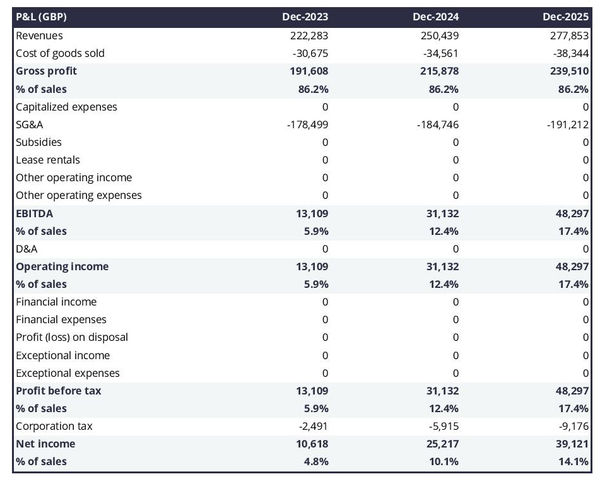
The following financial tables will be used to present your agronomy consulting company's financial forecast.
The projected P&L statement
Your agronomy consulting company's forecasted P&L statement will enable you to visualise your agronomy consulting company's expected growth and profitability over the next three to five years.
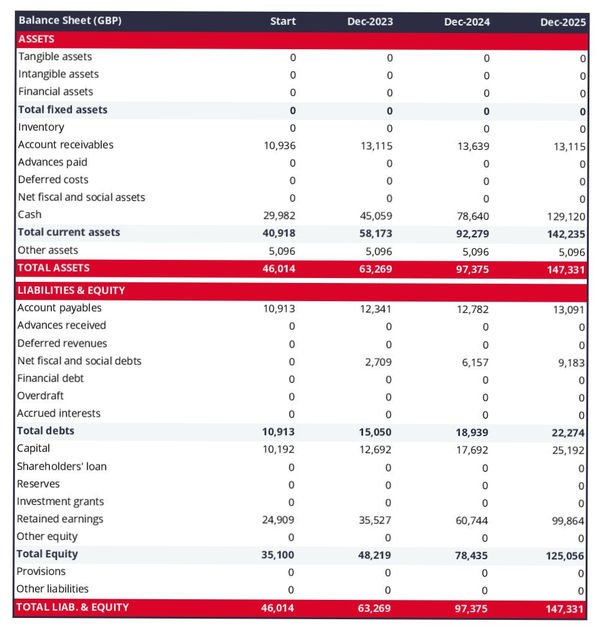
The projected balance sheet of your agronomy consulting company
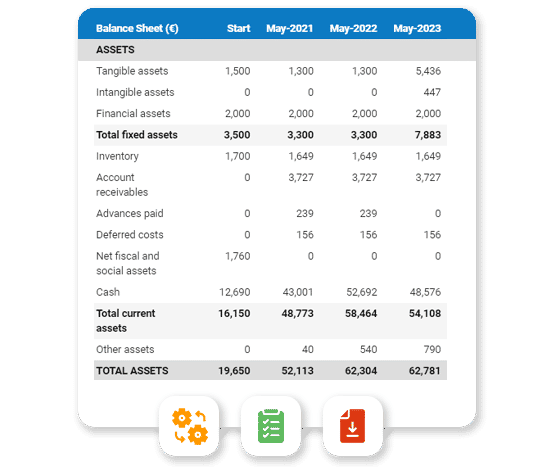
The projected balance sheet gives an overview of your agronomy consulting company's financial structure at the end of the financial year.
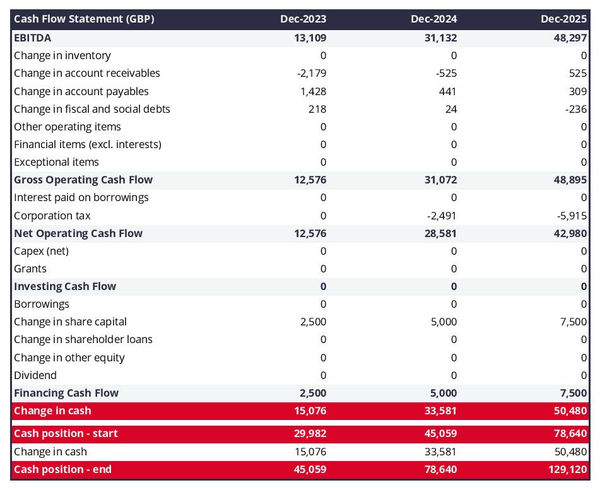
The cash flow projection
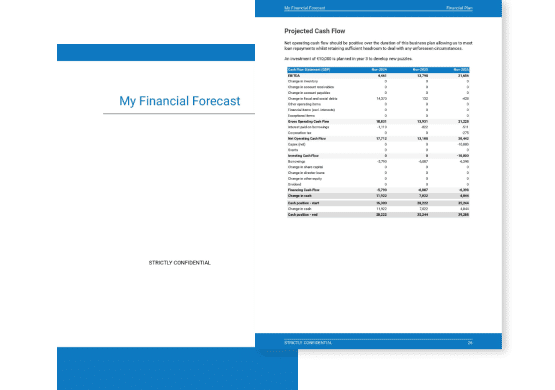
A cash flow forecast for an agronomy consulting company shows the projected inflows and outflows of cash over a specific period, providing insights into liquidity and financial health.
What is the best financial forecasting tool for starting your agronomy consulting company?
The simplest and easiest way to create your agronomy consulting company's projections is to use professional online financial forecasting software such as the one we offer at The Business Plan Shop.
There are several advantages to using specialised software:
- You can easily create your financial forecast by letting the software take care of the financial calculations for you without errors
- You have access to complete financial forecast templates
- You get a complete financial forecast ready to be sent to your bank or investors
- The software helps you identify and correct any inconsistencies in your figures
- You can create scenarios to stress-test your forecast's main assumptions to stress-test the robustness of your business model
- After you start trading, you can easily track your actual financial performance against your financial forecast, and recalibrate your forecast to maintain visibility on your future cash flows
- You have a friendly support team on standby to assist you when you are stuck
If you are interested in this type of solution, you can try our forecasting software for free by signing up here.
Finding a name and registering your agronomy consulting company
The next step in starting an agronomy consulting company is to decide on a name for your entity.
For starters, you cannot take a name similar to a name already registered by a competitor or protected by a trademark without inevitably risking getting sued. So you’ll need to find a name available, and reserve it before others can.
In addition, you will probably want to use the same name for:
- Your company’s legal name - Example LTD or Example Inc
- Your trading name - Example
- A trademark - Example ®
- Your company’s domain name - Example.com
The issue is that you’ll need to register your name in three different places almost simultaneously, but with each place having its own timeframes:
- Registering a domain name is instantaneous
- Registering a trademark takes at least 3 months (if your application is accepted)
- Registering a company depends on the country, but it's generally fairly quick
You will therefore be faced with the choice of either registering everything at once in the hope that your name will be accepted everywhere, or proceeding step by step in order to minimise costs, but taking the risk that someone else will register one of the names you wanted in the meantime.
Our advice is to discuss the strategy with your legal counsel (see further down in this guide) and to give priority to your domain names and your registered trademark. You'll always have the option of using a trading name that's different from your company's legal name, and that's not a big deal.
To check that the name you want is not already in use, you should consult:
- Your country's business register
- The register of trademarks where you wish to obtain protection
- Your preferred search engine
- A domain name reservation company (such as GoDaddy)
If the name you want is available, you can go ahead and register it.
Need inspiration for your business plan?
Avoid writer's block and draft your own business plan in no time by drawing inspiration from dozens of business plan templates.
What corporate identity do I want for my agronomy consulting company?
The following step to start an agronomy consulting company is to define your company's visual identity.
Visual identity is part of the DNA of your agronomy consulting company: it makes you recognizable and recognized by your customers, and helps you stand out from the competition. It also helps convey your values, notably through the choice of colors that identify the company.
Creating your business's visual identity yourself is entirely possible: there are several online tools that let you generate color palettes, choose typography and even generate logos.
However, we advise you to delegate this task to a designer or a communications agency for a professional result.
Your corporate identity will include the following elements:
- Your business logo
- Your brand guidelines
- Your business cards
- Design and theme of your website
Logo
Your agronomy consulting company's logo serves as a quick identifier for your company. It will be featured on all your communication platforms (website, social networks, business cards, etc.) and official documents (invoices, contracts, etc.).
Beyond its appearance, your logo should be easy to use on any type of support and background (white, black, gray, colored, etc.). Ideally, it should be easy to use in a variety of colors.
Brand guidelines
One of the challenges when starting an agronomy consulting company is to ensure a consistent brand image wherever your company is visible.
This is the role of your company's brand guidelines, which defines the typography and colors used by your brand and thus acts as the protector of your brand image.
Typography refers to the fonts used (family and size). For example, Trebuchet in size 22 for your titles and Times New Roman in size 13 for your texts.
The colors chosen to represent your brand should typically be limited to five (or fewer):
- The main colour,
- A secondary colour (the accent),
- A dark background colour (blue or black),
- A grey background colour (to vary from white),
- Possibly another secondary colour.
Business cards
Classic but a must-have, your business cards will be at your side to help you easily communicate your contact details to your founders, customers, suppliers, recruitment candidates, etc.
In essence, they should feature your logo and adhere to the brand guidelines mentioned earlier.
Website theme
Likewise, the theme of your agronomy consulting company website will integrate your logo and follow the brand guidelines we talked about earlier.
This will also define the look and feel of all your site's graphic elements:
- Buttons
- Menus
- Forms
- Banners
- Etc.
Navigate the legal and regulatory requirements for launching your agronomy consulting company
The next thing to do in getting an agronomy consulting company off the ground is to handle all the legal and regulatory requirements. We recommend that you be accompanied by a law firm for all of the steps outlined below.
Intellectual property
One of your priorities will be to ensure that your company's intellectual property is adequately protected.
As explained before, you can choose to register a trademark. Your lawyer can help you with a detailed search to make sure your chosen trademark is unique and doesn't clash with existing ones.
They'll assist in preparing the required documents and steer you in picking the right categories and locations for trademark registration.
Moreover, your lawyer can offer guidance on additional measures to protect other intellectual property assets your company may have.
Getting your agronomy consulting company paperwork in order
For day-to-day operations, your agronomy consulting company will need to rely on a set of contractual documents.
Your exact needs in this respect will depend on the country in which you are launching your agronomy consulting company, the number of partners and the envisaged size of the company.
However, you will probably need at least the following documents:
- Employment contracts
- General terms and conditions of sale
- General terms and conditions of use for your website
- Privacy Policy for your website
- Cookie Policy for your website
- Invoices
- Etc.
Applying for licences and permits and registering for various taxes
Operating your business legally may require licences and business permits. The exact requirements applicable to your situation will depend on the country in which you set up your agronomy consulting company.
The lawyers who advise you will also be able to guide you with regard to all the rules applicable to your business.
Similarly, your accountant will be able to help you take the necessary steps to comply with the tax authorities.
Need a convincing business plan?
The Business Plan Shop makes it easy to create a financial forecast and write a business plan to help convince investors that your business idea can be profitable.
How do I write a business plan for an agronomy consulting company?
Once you've completed all the above steps, you can start writing the business plan for your agronomy consulting company.
What is a agronomy consulting company's business plan?
The business plan is a document containing:
- The financial forecast (discussed earlier in this guide), highlighting the project's financing requirements and profitability potential,
- A written presentation, which presents your project in detail and provides the necessary context for the reader to assess the relevance and coherence of your forecast.
The business plan is particularly important: it will help you validate your business idea and ensure its coherence and financial viability.
But it's also the document you'll send to your bank and potential investors to present your plan to open an agronomy consulting company and make them want to support you.
So it's best to draw up a professional, reliable and error-free business plan.
How to write a business plan for my agronomy consulting company?
If you're not used to writing business plans, or if you want to save time, a good solution is to use an online business plan software for startups like the one we offer at The Business Plan Shop.
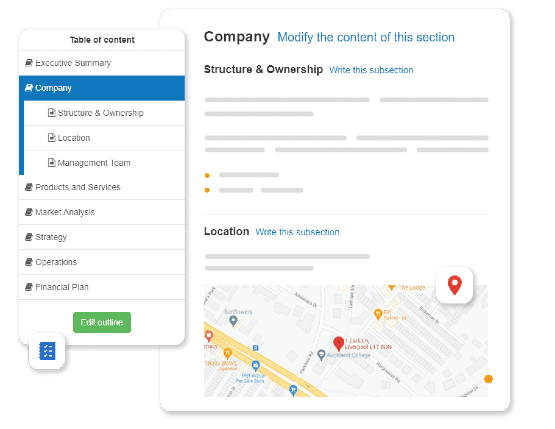
Using The Business Plan Shop to create a business plan for an agronomy consulting company has several advantages:
- You can easily create your financial forecast by letting the software take care of the financial calculations for you without errors
- You are guided through the writing process by detailed instructions and examples for each part of the plan
- You can access a library of dozens of complete startup business plan samples and templates for inspiration
- You get a professional business plan, formatted and ready to be sent to your bank or investors
- You can create scenarios to stress test your forecast's main assumptions
- You can easily track your actual financial performance against your financial forecast by importing accounting data
- You can easily update your forecast as time goes by to maintain visibility on future cash flows
- You have a friendly support team on standby to assist you when you are stuck
Interested? If so, you can try The Business Plan Shop for free by signing up here.
Need a convincing business plan?
The Business Plan Shop makes it easy to create a financial forecast and write a business plan to help convince investors that your business idea can be profitable.
How to raise finance for my agronomy consulting company?
Once your business plan has been drafted, you’ll need to think about how you might secure the financing necessary to open your agronomy consulting company.
The amount of initial financing required will obviously depend on the size of your agronomy consulting company and the country in which you wish to set up.
Businesses have access to two main categories of financing: equity and debt. Let's take a closer look at how they work and what sources are available.
Equity funding
At a high level, the equity of your agronomy consulting company will consist of the money that founders and potential investors will invest to launch the company.
Equity is indispensable as it provides the company with a source of long-term (often permanent) financing and demonstrates the founders' conviction in the company's chances of success, since their investments would be lost in the event of bankruptcy.
Equity investors can generate a return on their investment through dividends (which can only be paid out if the company is profitable) or capital gains on the resale of their shares (if the company is attractive enough to attract a buyer).
As you can see, the equity investors' position is extremely risky, since their capital is at risk and can be lost in the event of bankruptcy, and the company must be profitable or resellable before they can hope to generate a return on their investment.
On the other hand, the return on investment that equity investors can expect to generate by investing in an agronomy consulting company can be very substantial if the company is successful.
This is why equity investors look for start-up ideas with very high growth or profitability potential, in order to offset their risk with a high potential return on investment.
In technical terms, equity includes:
- Share capital and premiums: which represent the amount invested by the shareholders. This capital is considered permanent as it is non-refundable. In return for their investment, shareholders receive shares that entitle them to information, decision-making power (voting in general assembly), and the potential to receive a portion of any dividends distributed by the company.
- Director loans: these are examples of non-permanent capital advanced to the company by the shareholders. This is a more flexible way of injecting some liquidity into your company than doing so as you can repay director loans at any time.
- Reserves: these represent the share of profits set aside to strengthen the company's equity. Allocating a percentage of your profits to the reserves can be mandatory in certain cases (legal or statutory requirement depending on the legal form of your company). Once allocated in reserves, these profits can no longer be distributed as dividends.
- Investment grants: these represent any non-refundable amounts received by the company to help it invest in long-term assets.
- Other equity: which includes the equity items which don't fit in the other categories. Mostly convertible or derivative instruments. For a small business, it is likely that you won't have any other equity items.
The main sources of equity are as follows:
- Money put into the business from the founders' personal savings.
- Money invested by private individuals, which can include business angels, friends, and family members.
- Funds raised through crowdfunding, which can take the form of either equity or donations (often in exchange for a reward).
- Government support to start-ups, for example, loans on favourable terms to help founders build up their start-up capital.
Debt funding
The other way to finance your agronomy consulting company is to borrow. From a financial point of view, the risk/return profile of debt is the opposite of that of equity: lenders' return on investment is guaranteed, but limited.
When it borrows, your company makes a contractual commitment to pay the lenders by interest, and to repay the capital borrowed according to a pre-agreed schedule.
As you can see, the lenders' return on investment is independent of whether or not the company is profitable. In fact, the only risk taken by lenders is the risk of the company going bankrupt.
To avoid this risk, lenders are very cautious, only agreeing to finance when they are convinced that the borrowing company will be able to repay them without problems.
From the point of view of the company and its stakeholders (workforce, customers, suppliers, etc.), debt increases the risk of the venture, since the company is committed to repaying the capital whether or not it is profitable. So there's a certain distrust towards heavily indebted companies.
Companies borrow in two ways:
- Against their assets: this is the most common way of borrowing. The bank finances a percentage of the price of an asset (a vehicle or a building, for example) and takes the asset as collateral. If the company cannot repay, the bank seizes the asset and sells it to limit its losses.
- Against their future cash flows: the bank reviews the company's financial forecast to estimate how much the company can comfortably borrow and repay, and what terms (amount, interest rate, term, etc.) the bank is prepared to offer given the credit risk posed by the company.
When creating an agronomy consulting company, the first option is often the only one available, as lenders are often reluctant to lend on the basis of future cash flows to a structure that has no track record.
The type of assets that can be financed using the first method is also limited. Lenders will want to be sure that they can dispose of foreclosed assets if needed, so they need to be assets that have an established second-hand market.
That being said, terms and conditions also depend on the lender: some banks are prepared to finance riskier projects, and not all have the same view of your company's credit risk. It also depends on the collateral you can offer to reduce risk, and on your relationship with the bank.
In terms of possible sources of borrowing, the main sources here are banks and credit institutions.
In some countries, it's also possible to borrow from private investors (directly or via crowdlending platforms) or other companies, but not everywhere.
Takeaways on how to finance an agronomy consulting company
Multiple options are available to help you raise the initial financing you need to launch your agronomy consulting company.
There are two types of financing available to companies. To open an agronomy consulting company, an equity investment will be required and may be supplemented by bank financing.
Track your actuals against your forecast
You've reached the end of the road and are ready to launch your agronomy consulting company.
Congratulations and welcome to the fantastic world of entrepreneurship! Celebrate the work you've done so far, and get back to work quickly, because this is where the real work begins.
Your first priority will be to do everything you can to make your business sustainable (and thus avoid being one of the 50% of start-ups that fail within five years of launching).
Your business plan will be your best ally to ensure that you're on track to achieve your objectives, or to help rectify the situation if necessary.
The key to financial management is to regularly compare your actual accounting data with your agronomy consulting company forecasts, in order to be able to :
- Quantify the gaps between what you planned and what you achieved
- Adjust your financial forecasts as the year progresses to maintain visibility over your future cash flow
No one can predict the future with certainty, but by closely monitoring the variances between actuals and forecasts, regularly adjusting your forecasts and simulating several scenarios, you can prepare your agronomy consulting company for the worst while hoping for the best.
It's the only way to keep an eye on your cash flow and actively manage the development of your agronomy consulting company, ultimately reducing the risk to your company.
There's nothing worse than waiting for your company's annual accounts to close, which can be many months after the end of your financial year (up to nine months in the UK for example), only to realize that you've fallen far short of your forecasts for the past year, and that your agronomy consulting company urgently needs a cash injection to keep going.
That's why it's strongly recommended to use a financial planning and analysis solution that integrates forecasting, scenario analysis, and actuals vs. forecast tracking, like we do at The Business Plan Shop with our financial dashboards.
Need inspiration for your business plan?
Avoid writer's block and draft your own business plan in no time by drawing inspiration from dozens of business plan templates.
Key takeaways
- To open an agronomy consulting company you need to go through each of the 15 steps we have outlined in this guide.
- The financial forecast is the tool that will enable you to check that your project can be profitable and to estimate the investment and initial financing requirements.
- The business plan is the document that your financial partners will ask you to produce when seeking finance.
- Once you have started trading, it will be essential to keep your financial forecasts up to date in order to maintain visibility of the future cash flow of your agronomy consulting company.
- Leveraging a financial planning and analysis platform that seamlessly integrates forecasts, business plans, and real-time performance monitoring — like The Business Plan Shop — simplifies the process and mitigates risks associated with launching a business.
We hope this practical guide has given you a better understanding of how to open an agronomy consulting company. Please do not hesitate to contact our team if you have any questions or if you would like to share your experience of setting up your own business.
Also on The Business Plan Shop
Do you know someone who is thinking about opening an agronomy consulting company? Share our guide with them!

Founder & CEO at The Business Plan Shop Ltd